Thrumline, a free knitting pattern from Knitty.com.
INTRODUCTION
Thrumline
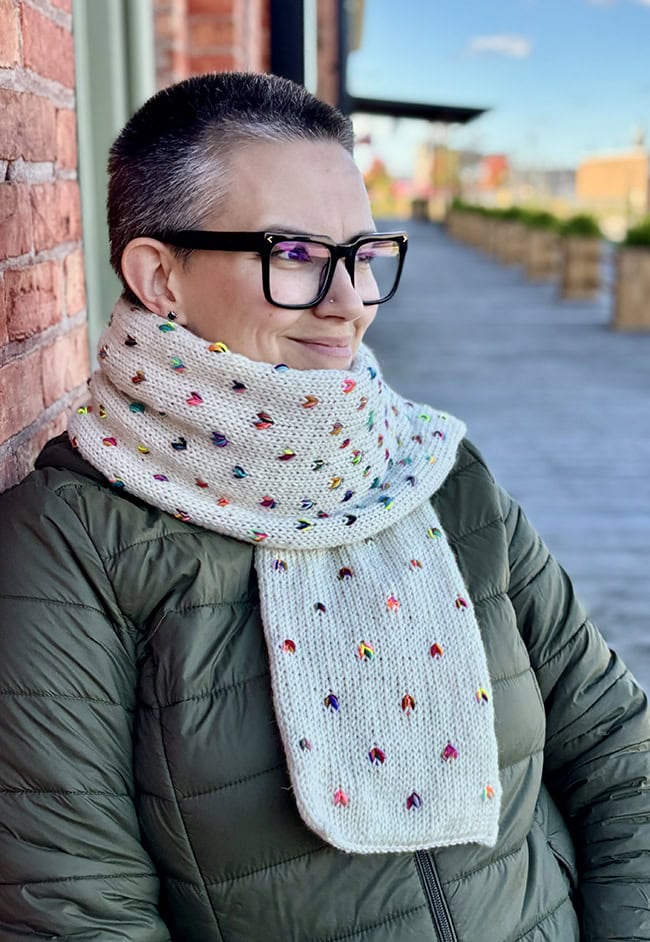
by Gillian McLeod, Fibres of My Being

Every knitter has little leftover bits of yarn too precious to toss, but not quite enough for a full project. Enter Thrumline, where thrums made from your scraps take center stage.
Thrums, while practical, are also… magical. Each thrum is different, a reminder of past projects: your favorite sweater, the socks you never wanted to take off, the shawl you gifted. As you knit this scarf, you'll not only be reminded of those past projects, but hopefully inspired to create new ones, as you watch the different yarns and colors combine.
This pattern can be easily modified. Knit in the round, using a worsted weight yarn and scraps of all weights, you get to play and decide. Do you use ALL the thrums, use only a few, make it short, make it long? The choice is up to you. Make it monochromatic, use all the colors, make a fade, choose random, maybe cool colors or warm colors; it's all your choice.
So, collect your scraps, your leftover yarn from your favorite sweaters or pairs of socks, the trimmed ends, the oddments, or the 20-gram minis you've been saving and create a cozy, squishy scarf, full of memories and stories of past projects.
 model: Gillian McLeod
photos: Gillian McLeod and her son
SIZE
One
Length is adjustable.
FINISHED MEASUREMENTS
Length: 54 inches /137 cm
Width:
6.5 inches/16.5 cm
MATERIALS
Yarn
[MC] Cascade 220 Solid [100% Peruvian Highland Wool; 220 yd/200m per 3.5 oz/100 g skein]; color: 8010 Natural Raw White; 2-3 skeins. Knit until you run out of yarn. At given gauge, the sample used 2 skeins.
[CC] Scraps of fingering weight, DK, or even worsted and lace, cut into approx. 6 in/15 cm pieces. Approximately 3.5 oz / 100 g or 400 yds /365 m total.
Yarn Characteristics
The body of the scarf is worked in smooth worsted-weight, non-superwash wool. The thrums are created from scraps of yarn – the sample uses mostly fingering weight/sock yarn, but other weights can also be used. The body of the scarf is best worked in a solid color; the other yarns can be any type of coloring, solid, variegated, etc.
Traditionally, thrums are added to create a warm and durable layer. This is done by using non-superwash fibres, which then felt with wear. For this scarf, the thrums don't need to be felted, as they are encased. Multi-stranded thrums, even if entirely or mostly superwash, should stay in place. It can help to add a strand of mohair or another non-superwash into each thrum, but it is not necessary.
Recommended needle size
[always use a needle size that gives you the gauge listed below - every knitter's gauge is unique]
US#8/5mm circular needle, 32-40 inch/80-100 cm for magic loop OR 2 16-20 inch/40-50 cm circular needles for the two-circulars method
Optional: US#8/5mm circular needle, 16-inch/40-cm, or needle size to obtain gauge.
A spare needle the same size or slightly smaller, for working a three-needle bind off.
Notions
3 stitch markers
yarn needle
GAUGE
18 sts/23 rounds = 4 inches/10 cm in stockinette stitch.
PATTERN NOTES
[Knitty's list of standard abbreviations and techniques can be found here.]
Construction method: The scarf is worked in the round, with the thrums placed on the first half of the round only. To minimize the finishing, it starts with a Turkish Cast-On (think toe-up socks) and ends with a three-needle bind-off.
Length: You can adjust the length of the scarf, adding or removing pattern sections/repeats. There are three different sections for the thrums, each increasing the amount of space between the stitches and rounds to create a cascading or fading look. You can complete them in any order and/or combination, or just choose one for the entire scarf. To add length, it will look most balanced if you reverse the pattern by working Section B after C, and then section A after B.
Techniques:
- Thrums
Collect your yarn leftovers in your preferred color(s). Each thrum will be composed of multiple strands of yarn, and you can make them generally monochromatic or wildly multi-colored. You can create a fade effect, or mix things up.
Cut the yarns into 6-inch/15-cm long pieces. An individual thrum needs approximately 6 strands of yarn. The thickness of the thrum should be a little thicker than the main yarn being used, approximately a quarter of an inch/half a cm. The sample shows a mix of random colors made this way: after cutting strands, put them in a bag and shake them up to mix the colors well.
Make piles of about 6 strands. Some examples:
- 4 strands of fingering/sock weight, 1 strand of worsted weight
- 5 strands of fingering/sock weight, 2 strands of lace weight
- 3 strands of fingering/sock weight, 2 strands of worsted weight and 1 strand of lace weight - K thrum - Working a Thrummed stitch:
Insert your right-hand needle into the stitch below the stitch on your left needle. Fold your thrum (strands of yarn) in half over the right-hand needle tip and pull it through. Knit the next stitch as normal, then pass the thrum over the stitch just worked. Give the thrum a little pull from behind to tighten and straighten it up. - Turkish Cast-on: (Video and photo tutorial) Place the tips of both needles parallel to each other, with the tips facing to the left. Create a slip knot and place it on the needle on top. With your working yarn (not your tail), start to wrap your yarn from behind, coming under the needles and forward and over both needles (counter-clockwise), until you have 30 wraps on your needles (half as many wraps as the number of stitches required). Securing the yarn so it doesn't come unravelled, rotate your needles so your tips are now facing the right. Pull the bottom needle out and knit across all the loops on the top needle. When you come to the end of the first set of stitches, tug gently on the cord loop so that both sets of stitches are sitting on the needle tips. Then rotate the needles, so the tips are facing the right. Pull the bottom needle out – the one that doesn't have working yarn attached. The first stitch will be your slip knot – let that drop off the needle; then knit across the second set of stitches. As before, tug on the looped cord to move both sets of stitches onto the needle tips. 60 sts.
- Flat Three-needle Bind off
Note that this is slightly different from the standard method
DIRECTIONS
Using MC, your longer circular needle or two short circulars, and the Turkish Cast on method (or your preferred method for a "joined"/"closed" round, e.g. Judy's Magic Cast on method), CO 60 stitches. Note or mark start of the round.
Continuing with your magic loop/2 circulars needles, knit 6 rounds.
Weave in the cast-on end now while you still have easy access.
Section A
Round 1: K2, k thrum, [k5, k thrum] 4 times, k to end of round.
Knit 3 rounds.
Round 5: [K5, k thrum] 4 times, k to end of round.
Knit 3 rounds.
Repeat these last 8 rounds 11 more times.
Note: As you work these rounds, you might prefer to change to a single shorter circular needle. If you do, place a marker on the needle for the start of the round. You might also find it helpful to mark the midpoint of the round, to keep track of the patterned and plain sections.
Section B
Round 1: K4, k thrum, [k7, k thrum] 3 times, k to end of round.
Knit 5 rounds.
Round 7: [K thrum, k7] 3 times, k to end of round.
Knit 5 rounds.
Repeat these last 12 rounds 5 more times, Rounds 1-6 once more.
Section C
Round 1: K6, k thrum, [k9, k thrum] twice, k to end of round.
Knit 7 rounds.
Round 9: K1, [k thrum, k9] 3 times, k to end of round.
Knit 7 rounds.
Repeat these last 16 rounds 7 more times.
Bind off with a Flat three-needle bind off. (This is not a standard three-needle bind off; see Pattern Notes for a tutorial.)
FINISHING
Check over your scarf for any thrums that may have disappeared, been pulled too tight, or that have partially disappeared. Take your darning needle and gently slide it under the thrum strands and give it a little wiggle (see photo below). You can also just use your hands and give it a tiny pull.
Wash and lay flat to dry, or steam block by laying your scarf out flat, either on an ironing board or other flat surface. Hold your iron or steamer over your scarf without ever touching it. Go over it a few times, enough to saturate it. Allow your piece to dry completely before moving it. Note: Be careful if steaming acrylic; make sure to use medium heat and not get too close.
ABOUT THE DESIGNER
 Gillian loves playing with colour, texture, and unexpected yarn combinations, and finds inspiration in the most random places. This is just the beginning of her pattern-writing adventure, and she can't wait to see where the yarn takes her.
In addition to being an aspiring pattern designer, she's also a knitter, crocheter, and tech editor. She can't resist experimenting with all sorts of creative goodies: fibres, paints, recycling bits (she loves cardboard!), beads…
Pattern & images © 2025 Gillian McLeod, Fibres of My Being