Scotch Cove, a free knitting pattern from Knitty.com.
INTRODUCTION
Scotch Cove
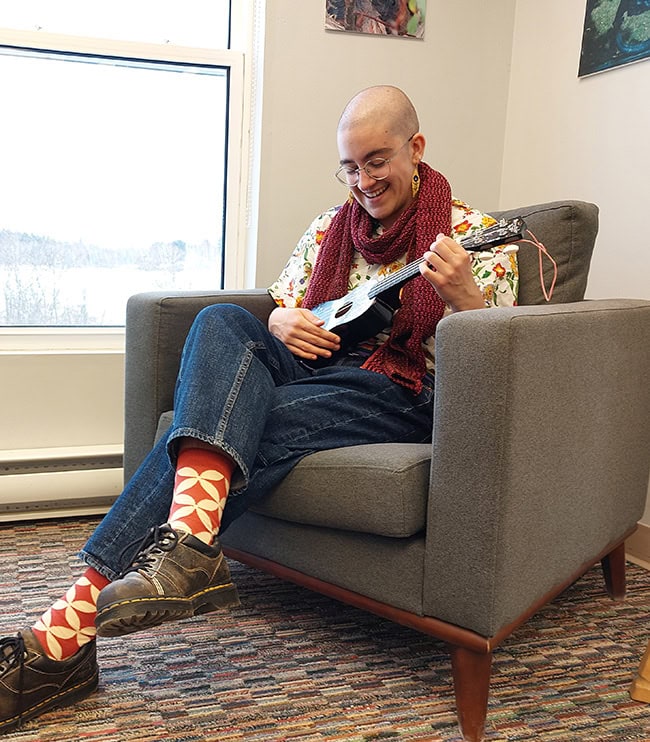
by Elizabeth Stregger

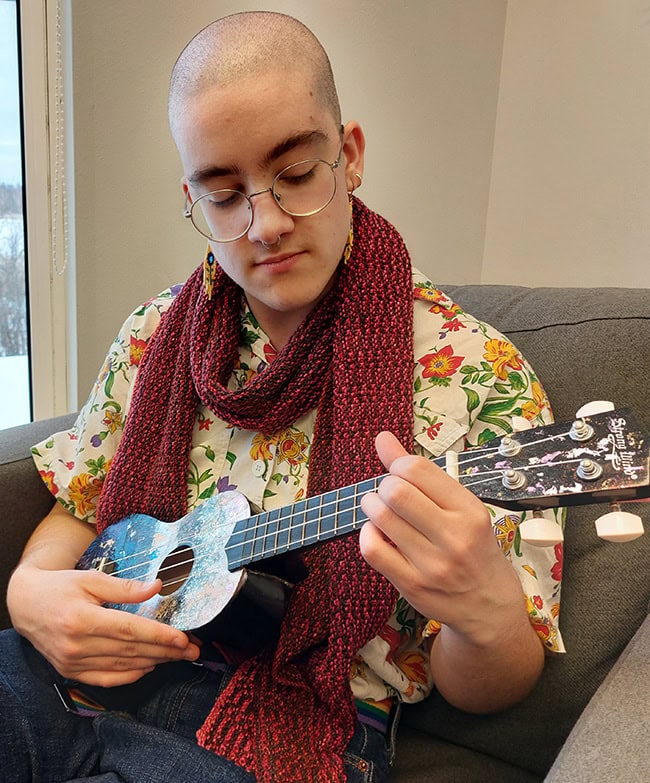
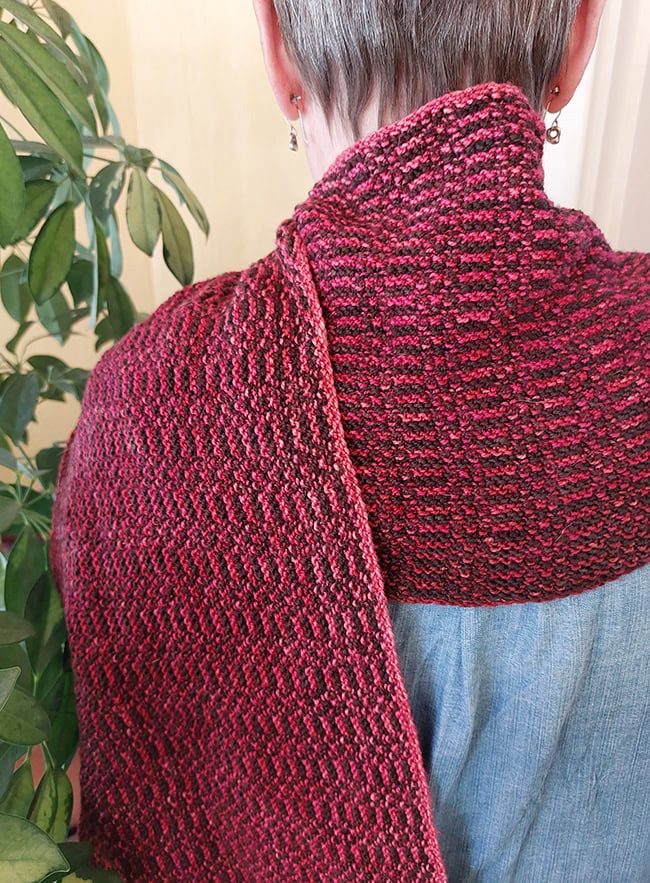
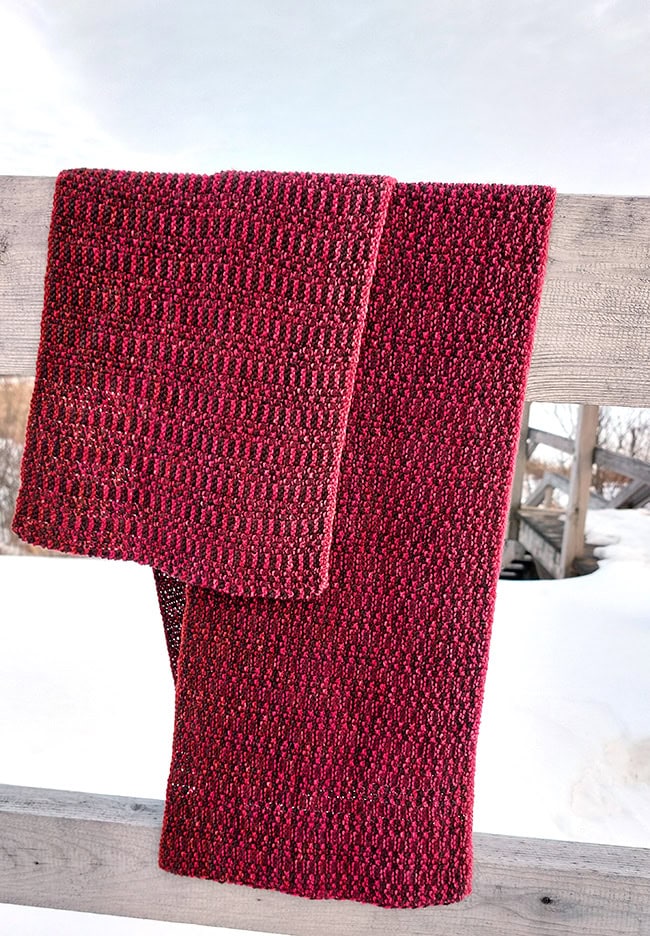
The simplest of patterns, Scotch Cove uses a short sequence of knits and purls, repeated over long rows, to build a surprisingly complex fabric. The right side shows pleasing horizontal and vertical stripes, while the reverse is tweedier, flecked, almost woven in appearance. The shifting colour of the gradient yarn adds to the richness of the finished fabric, while the slightly pleated effect gives the scarf a satisfying bounce.
This scarf is based on a six-stitch repeat, and inspired by Sequence knitting: Simple methods for creating complex fabrics by Cecelia Campochiaro. Knitting sequences feels good. The simple repeats flow through my fingers and quiet my busy mind; I find myself paying attention to the yarn, while setting my brain free to float. Picking up a project with such long rows feels like an invitation to slow down and sit for a while, to settle into a social interaction or relax into a sunbeam with my cat. The long rows in this scarf are a commitment to spend more time in these moments.
 model: Jan Zverev, Marit Munson
photos: Marit Munson, Elizabeth Stregger
SIZE
One
FINISHED MEASUREMENTS
Width: 8.75 inches/22 cm
Length: 73 inches/185 cm
MATERIALS
Yarn
Gobsmacked merino fingering [100% superwash merino; 395 yd/ 361 m per 100g skein];
[MC] Courage My Love; 1 skein
[CC] Grounded; 1 skein
Yarn Characteristics
This pattern is written for two skeins of superwash merino yarn, but any fingering-weight wool or wool blend with at least two plies would work well as a substitute. There's a lot of latitude for colour choices as well. To achieve the rich subtle effect of the scarf as shown, find a gradient that you love and then combine it with a semi-solid or tonal CC that is similar in hue to one end of the gradient. In this case, the pink-to-brown gradient contrasts with the brown of the CC at one end and melds with it at the other. Choosing colour ways that are similar in value (both light, both medium, or both dark) also helps build a quiet but complex fabric. An easy way to check the value of your colours is to take a photo and then change it to greyscale to see if they blend together. If you don't have a gradient, try two semi-solids or tonals, in low contrast for a subtle look or high contrast for more of a pop.
Recommended needle size
[always use a needle size that gives you the gauge listed below - every knitter's gauge is unique]
US #5/3.75mm needles for working flat
Notions
yarn needle
GAUGE
24 sts/32 rows = 4 inches/10 cm in stockinette stitch
21 sts/50 rows = 4 inches/10 cm in pattern stitch
PATTERN NOTES
[Knitty's list of standard abbreviations and techniques can be found here.]
Construction method: This scarf is knit flat, from side to side.
Adjusting length: Cast on a multiple of 6 stitches plus 1. Adjust the width by changing the number of pattern repeats. Each pattern repeat adds approximately 1 inch/2.5 cm. End with row 2 of the pattern and enough MC yarn to work the bind off.
Techniques:
- Cast on/bind offs suggested (these choices create flexible edges that allow the fabric to stretch and drape, and also neatly match):
- Long-tail cast on (photo tutorial, video tutorial)
- Elizabeth Zimmermann's sewn bind off (photo tutorial).
- In the sample, the new colour is carried up behind the yarn used in the previous stripe.
- This scarf is based on 1-row: Broken Garter [K2, 2(P1, K1)] on 6 +1 from Sequence knitting: Simple methods for creating complex fabrics by Cecelia Campochiaro.
CHARTS
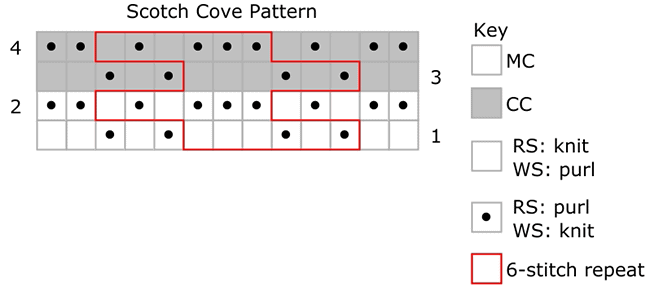
Scotch Cove Pattern:
Row 1 [RS]: Using MC, k2, (p1, k1, p1, k3) to last 5 sts, p1, k1, p1, k2.
Row 2 [WS]: Using MC, repeat Row 1.
Row 3: Using CC, repeat Row 1.
Row 4: Using CC, repeat Row 1.
DIRECTIONS
CO 385 sts.
Working from chart or written instructions, work Rows 1-4 27 times, or until desired width.
Repeat Rows 1-2 once more.
BO using Elizabeth Zimmermann's sewn bind off, using a tail of yarn measuring 220 inches/550 cm, or at least three times the length of your scarf.
FINISHING
Weave in ends. Block by soaking in warm water for 15 minutes, squeezing or spinning out the excess water, and laying the scarf out to dry. Ensure edges are aligned so that the scarf is a rectangle. Do not pin or stretch.
ABOUT THE DESIGNER
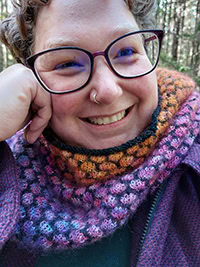 Elizabeth Stregger is an academic librarian who loves data, interesting textures, and weird neutrals. They live with their wife, Marit Munson, owner of Gobsmacked Yarn in Sackville, New Brunswick.
Pattern & images © 2025 Elizabeth Stregger.