Casting
on
"Jamie snorted
briefly and picked up a needle and a ball of yarn.
"It's no verra
difficult, Sassenach. Look- this is how ye cast
up your row."
Drawing the thread out
through his closed fist, he made a loop round his
thumb, slipped it onto the needle, and with a quick
economy of motion, cast on a long row of stitches
in a madder of seconds. Then he handed me the other
needle and another ball of yarn. "There –
you try.""
-- Diana Gabaldon, Drums
of Autumn

There are tons of different
techniques for casting on and most experienced knitters
likely have a favorite. New knitters will perhaps
only be familiar with one type - the favorite of
the person who taught them to knit. Learning several
different types of cast on lets you choose based
on the effect you want to achieve. Some techniques
give a firm, stable cast on edge while others yield
a softer, more elastic cast on edge. One thing you
never want is a cast on that's overly tight. On
a garment (socks, sleeves, caps, hems of all sorts)
a too tight cast on row is not only uncomfortable,
it will be under constant strain and therefore wear
out well before the rest of the knitting. And a
sweater hanging like a sack over a tight cast on?
Definitely a case of What Not to Wear.
If you have trouble --
like me -- keeping your cast on loose enough just
use a needle a couple of sizes larger (remember
to switch to the proper needles when you start to
knit!) or two needles held together. I find that
my own cast on rows vary depending on my mood and
surroundings and have learned to force myself to
rip out and start over if I'm not pleased with the
cast on after knitting the first couple of rows.
Not always easy, but it makes a huge difference
to final result.
The first thing to do when
beginning a cast on is make a slip knot -- a loop-type
knot that comes unraveled by pulling on one end
-- and place it on your needle.
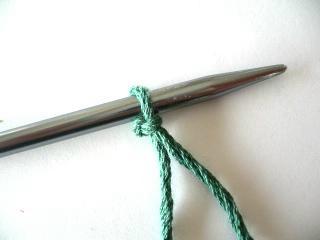
To
make a slip knot, arrange the yarn like this:
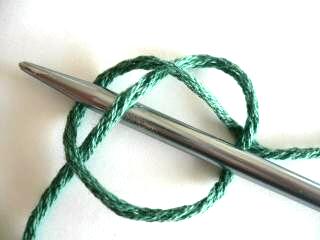
...then simply raise the
needle and tug the yarn end. Make sure the loop
gets tighter when you pull on the loose yarn end
rather than the end that is attached to the yarn
ball. If not you'll inevitably wind up with a sloppy
looking knot at the beginning of the cast on row.
The length of your loose
yarn end will depend on what type of cast on you're
going to be using. The description of the cast on
usually gives this information. The two-needle casting
on techniques -- "knitting-on" and cable
for example -- don't require a yarn tail at all.
Just be sure to leave enough yarn to effectively
weave in or to start a seam later. The one-needle
cast on technique 'm going to illustrate here depends
on having a yarn tail long enough to complete the
cast on row. Too long and you're wasting precious
yarn. Too short and you'll likely be throwing the
needles across the room in frustration, though it
is possible to join an extra length of yarn if this
happens -- you'll just have a couple extra ends
to weave in afterwards.
Perhaps the simplest cast
on is known as "knitting
on". Fortunately it's also a marvelous method
of casting on -- even and nicely elastic. You'll
need 2 needles for this type of cast on.
Start with a slip knot
on the left hand needle. Leave a short tail. Insert
the right hand needle into the slip knot as if to
knit, wrap and pull through, just like a regular
knit stitch.
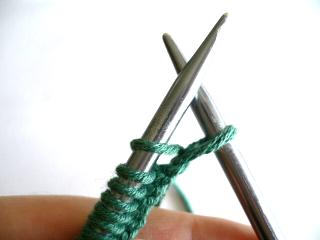
Place the newly created
stitch back onto the left hand needle. There are
two ways to accomplish the transfer of the newly
created stitch:
transferring it directly...
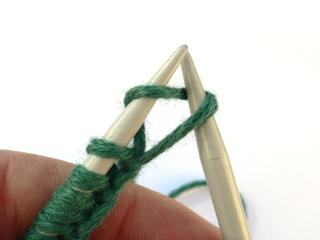
Or with a twist...
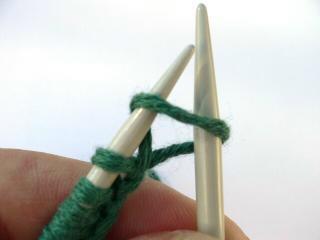
I find that transferring
it directly makes a neater cast on row, while twisting
it tends to be a bit looser. The most important
thing is to be consistent across the row.
Knitting on stitches in
this manner results in a cast on row that looks
like this...
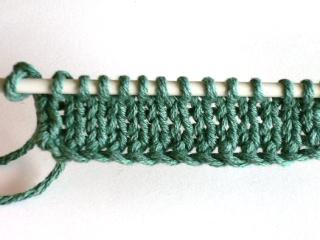
...and leaves you ready
to start a right side row in stockingette stitch.
(Some cast on methods leave purl bumps. We'll get
to that later.)
First off let me say that
the cable cast on has nothing to do with cables
and I don't know why it's called that.
Start by placing a slip
knot on the left hand needle. Again, you can leave
just a short tail. Knit on one stitch leaving 2
stitches now on the left hand needle. Now insert
the needle between the two stitches, wrap and bring
through. Transfer the newly created stitch onto
the left hand needle.
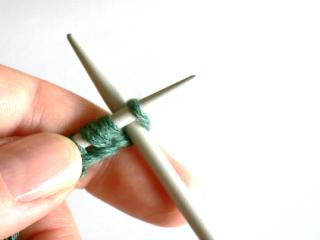
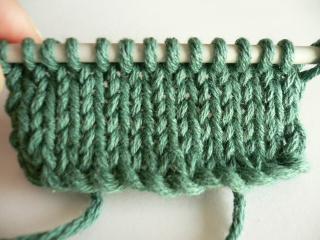
The cable cast on will
also you leave you set up to start with a knit row.
It is strong yet flexible and, according to Elizabeth
Zimmerman, "looks
equally well on both sides".
Leave a long tail on the
slip knot. I've seen several ways to guesstimate
how long the tail needs to be. One good way is to
cast on a small number of stitches, 10 for example,
then unravel to find out how much yarn is required
for that number of stitches and working out the
amount of yarn needed for the total number of stitches.
Another good way to avoid this problem is by using
two balls of yarn -- or both ends of the same ball
of yarn -- joined at the slip knot. Just cast on
one extra stitch and unknot the slip knot when you're
finished casting on. You'll only need one needle
for this method. Make a slip knot and place it on
the needle. Grab both ends of the yarn in your hand
and secure with your fingers. Then insert your thumb
and forefinger between the strands of yarn and pull
the needle downwards, creating a V shape with the
yarn, like so...
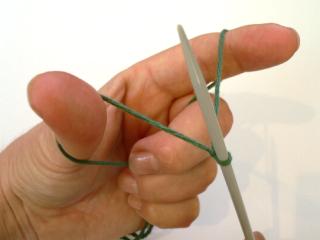
Holding the needle in your
right hand, bring the tip up through the loop on
your thumb...
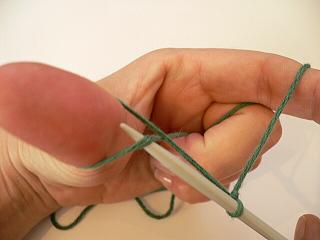
Then down through the loop
on your finger, grabbing the yarn...
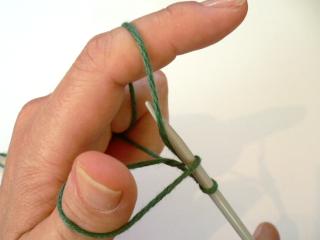
And pulling it down through
the loop on your thumb...
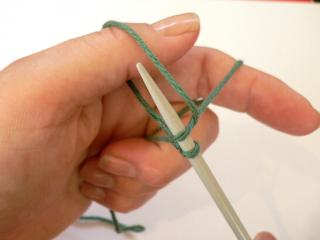
...let the loop of yarn
on your thumb slip off. Bring your thumb back under
the loose strand of yarn to tighten the stitch on
the needle.
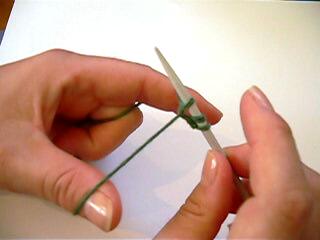
Repeat for each stitch
to be cast on.
And since I have a sneaking
suspicion that still images alone might be difficult
to follow, I've prepared this Quicktime
movie of long tail cast on. Right-click [PC]
or option-click [mac] to save it to your hard drive
to watch it as much as you need to, and save Knitty
a little bandwidth.
This type of cast on is
quite sturdy, but does have a tendency to be too
tight. I often use a larger needle than the one
that I'll be knitting with or two needles held together.
The long-tail cast on leaves a row of purl bumps,
so if you'll be knitting in stockingette stitch,
begin with a wrong side row.
Next issue: Yet
more ways to cast on!