





High Marsh Road, a free knitting pattern from Knitty.com.
INTRODUCTION
High Marsh Road
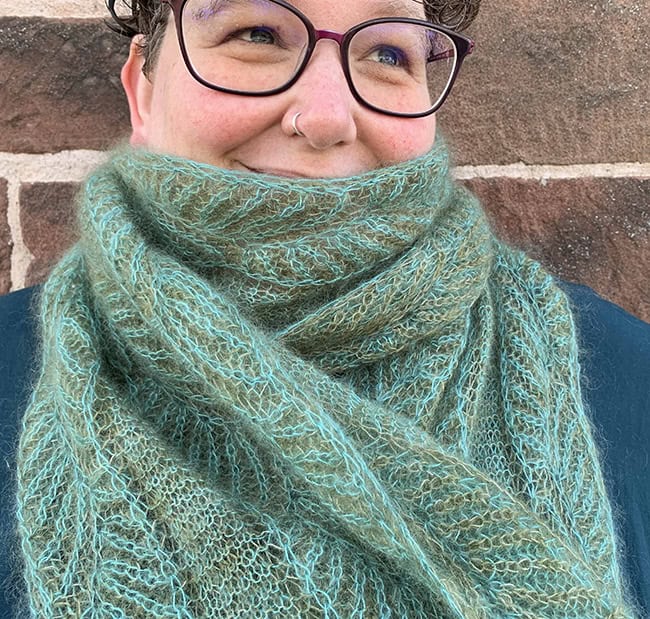
by Elizabeth Stregger

When I moved to Atlantic Canada a number of years ago, I fell in love with the light on the marshes. I live in New Brunswick, in a region that the Indigenous Mi'kmaq call Siknikt, the draining place. It is a landscape that blurs the line between land and water, where the famously high tides of the Bay of Fundy sweep across mudflats twice a day and dykes hold back the water from marshes and communal pastureland that sit just below sea level. On a warm fall evening, we drive out along the gravel road that cuts across the marsh, just to watch the warm sunlight cast long shadows across the grasses. When we stop the car to listen, the only sounds are birds and the rustle of the constant wind; the High Marsh Road is a magical place.
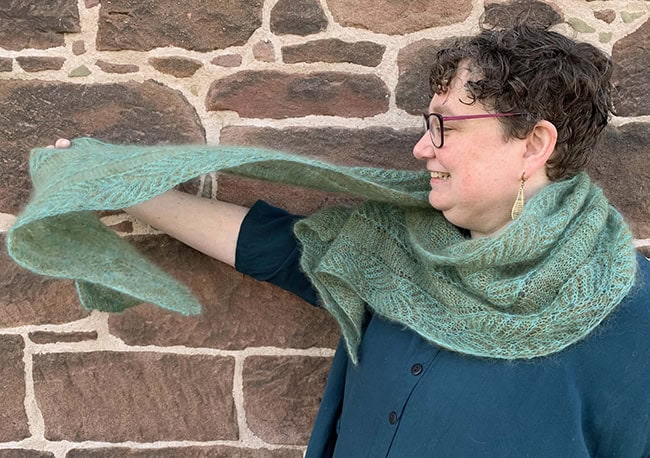
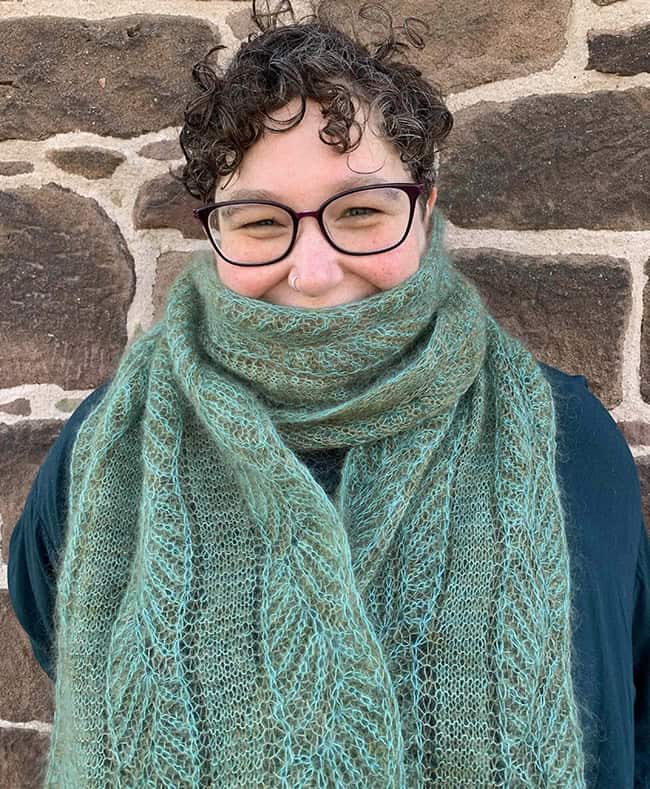
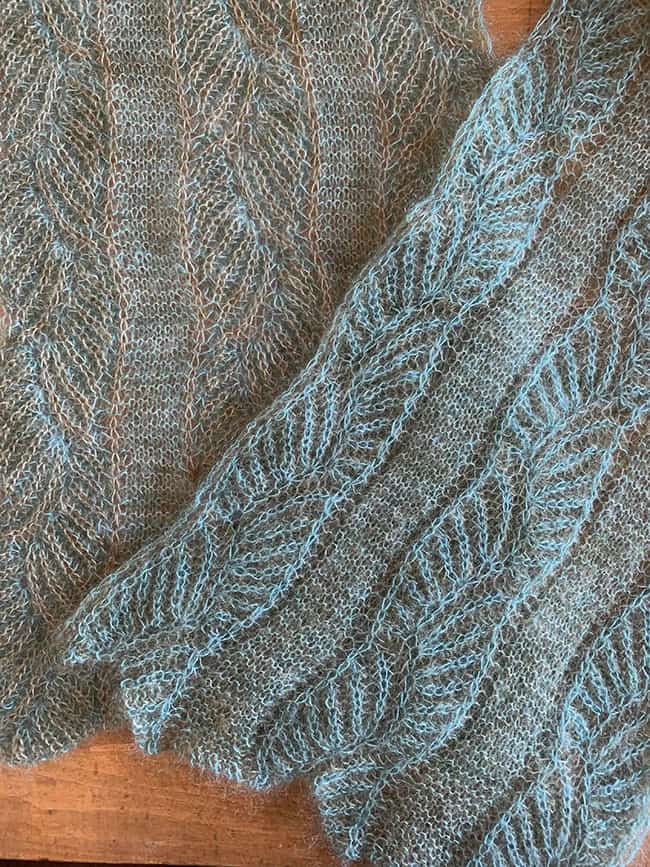
As I swatched this design, my mind kept returning to those soft fall evenings in the marsh light. The mohair diffuses the light and the silk glows, creating the same soft ethereal effect as the marsh light. The placement of the increases and decreases creates a gently undulating edge that mimics the contours of the marsh landscape, while the garter columns set up a pleasing rhythm (and a brief rest for your knitterly brain). The resulting scarf is elaborate, even elegant – and also a delightfully wearable lightweight fabric that is pleasingly warm for transitional seasons.
 model: Elizabeth Stregger
photos: Marit Munson



SIZE
One
FINISHED MEASUREMENTS
Width: 11.5 inches/29 cm
Length: 72 inches/183 cm
Length can be adjusted to suit available yardage.
MATERIALS
Yarn
Gobsmacked Yarn Fuzz [64% kid mohair, 36% silk; 459 yd/420 m per 50g skein];
[MC] Fox Heart; 1 skein
[CC] What Steeps in Marshes; 1 skein
Note: Sample uses about 80% of each skein; size can be adjusted to suit a
different yardage.
Yarn Characteristics
The sample shown uses a lace-weight mohair/silk blend. Choose a light yarn with a halo. The semi-solid colors chosen for the sample have low contrast when photographed in grayscale. This creates a soft melded effect in the garter stitch sections. For a similar effect, choose two colours that are close together on the light-to-dark spectrum. A higher contrast pairing will result in both a bolder brioche pattern and visible horizontal stripes in the garter stitch sections. A variegated yarn would work well for the CC, but stay with solid or nearly-solid colors for the MC.
Recommended needle size
[always use a needle size that gives you the gauge listed below - every knitter's gauge is unique]
US #7/4.5 mm circular needle, recommend 16-inch/40-cm or 24-inch/60-cm long for working flat
Notions
4 stitch markers
yarn needle
GAUGE
18 sts/28 rows = 4 inches/10 cm in stockinette stitch
14 sts/22 rows = 4 inches/10 cm in 2-colour brioche
19 sts/16 rows in High Marsh Brioche pattern repeat measures 2.75 inches/7 cm wide and 4.5 inches/11.5 cm long
Note: gauge is always taken after blocking.
PATTERN NOTES
[Knitty's list of standard abbreviations and techniques can be found here.]
Construction method: This scarf is worked in vertical stripes of two-colour brioche and garter stitch. Each row is worked twice on the right side (RS) of the scarf and then twice on the wrong side (WS). The main color (MC), shown in blue-green in the sample, is worked first on each side of the scarf. The stitches are then slid back to the other end of the circular needle. The contrast color (CC), shown in brown in the sample, is worked in the same direction. Only then is the scarf turned to work in the opposite direction. Circular needles are required so that the stitches can be returned to the working end for the second pass. Brioche increases and decreases worked on every fourth MC row create an undulating fabric. The High Marsh Brioche panel is a modified version of Wavy Treads from Nancy Marchant's book, Knitting Fresh Brioche: Creating Two Color Twists & Turns.
Brioche tips: See Kate Atherley's Wiseknit™ column in this issue for help making brioche knitting easier to understand
List of Abbreviations:
brk: brioche knit. Knit together next stitch and accompanying yarn over.
brp: brioche purl. Purl together next stitch and accompanying yarn over.
sl1yo: slip the next stitch, while wrapping the working yarn over the needle. With yarn in front, slip next stitch purlwise, bringing the yarn over the needle to the back and into position to work next stitch.
1-to-5 inc: 4 st brioche increase. Work (brk, yo, brk, yo, brk) into the next stitch and accompanying yarn over. 4 stitches increased.
brRsl: right-slanting 3-into-1 brioche decrease. Slip the first stitch knitwise. Knit the next stitch. Pass the slipped stitch over. Return the just-knit stitch back to the left-hand needle. Pass the following stitch over. Slip the stitch to the right-hand needle. 2 stitches decreased.
brLsl: left-slanting 3-into-1 brioche decrease. Slip the first stitch knitwise. Brk the next two stitches together. Pass the slipped stitch over. 2 stitches decreased.
MC: main color. It is dominant on the right side (RS) of the scarf.
CC: contrast color. It is dominant on the wrong side (WS) of the scarf.
Sl1p: slip 1 purlwise. At the end of a CC row, if you have just worked a brp1, drop the working yarn to the front; if you have just worked a brk, drop the yarn to the back. At the beginning of a CC row, the yarn will already be in the correct location for your first worked stitch. The CC colour never crosses the edge stitch.
- Techniques:
Two-color brioche, working from brioche charts, brioche increases and decreases:
Knitting Fresh Brioche: Creating Two Color Twists & Turns. by Nancy Marchant - Brioche increase and decrease (photos)
- Two-color Italian Cast-On (video)
- Italian Bind-off (video)
CHARTS
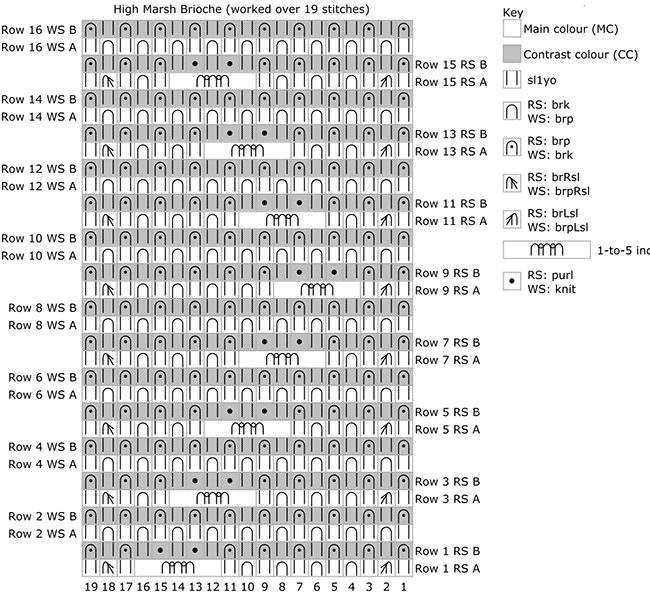
High Marsh Brioche Pattern (worked over 19 stitches):
Row 1B [RS, with CC]: (Brp, sl1yo) 6 times, (p1, sl1yo) twice, brp, sl1yo, brp. Turn.
Rows 2A, 4A, 6A, 8A, 10A, 12A, 14A, 16A [WS, with MC]: (Sl1yo, brp) 9 times, sl1yo. Do not turn, slide.
Rows 2B, 4B, 6B, 8B, 10B, 12B, 14B, 16B [WS, with CC]: (Brk, sl1yo) 9 times, brk. Turn.
Row 3A [RS, with MC]: Sl1yo, brLsl, (sl1yo, brk) 3 times, sl1yo, 1-to-5 inc, sl1yo, brk, sl1yo, brRsl, sl1yo. Do not turn, slide.
Row 3B [RS, with CC]: (Brp, sl1yo) 5 times, p1, sl1yo, p1, (sl1yo, brp) 3 times. Turn.
Row 5A [RS, with MC]: Sl1yo, brLsl, (sl1yo, brk) twice, sl1yo, 1-to-5 inc, (sl1yo, brk) twice, sl1yo, brRsl, sl1yo. Do not turn, slide.
Row 5B [RS, with CC]: (Brp, sl1yo) 4 times, p1, sl1yo, p1, (sl1yo, brp) 4 times. Turn.
Row 7A [RS, with MC]: Sl1yo, brLsl, sl1yo, brk, sl1yo, 1-to-5 inc, (sl1yo, brk) 3 times, sl1yo, brRsl, sl1yo. Do not turn, slide.
Row 7B [RS, with CC]: (Brp, sl1yo) 3 times, p1, sl1yo, p1, (sl1yo, brp) 5 times. Turn.
Row 9A [RS, with MC]: Sl1yo, brLsl, sl1yo, 1-to-5 inc, (sl1yo, brk) 4 times, sl1yo, brRsl, sl1yo. Do not turn, slide.
Row 9B [RS, with CC]: (Brp, sl1yo) twice, p1, sl1yo, p1, (sl1yo, brp) 6 times. Turn.
Row 11A [RS, with MC]: Sl1yo, brLsl, sl1yo, brk, sl1yo, 1-to-5 inc, (sl1yo, brk) 3 times, sl1yo, brRsl, sl1yo. Do not turn, slide.
Row 11B [RS, with CC]: (Brp, sl1yo) 3 times, p1, sl1yo, p1, (sl1yo, brp) 5 times. Turn.
Row 13A [RS, with MC]: Sl1yo, brLsl, (sl1yo, brk) twice, sl1yo, 1-to-5 inc, (sl1yo, brk) twice, sl1yo, brRsl, sl1yo. Do not turn, slide.
Row 13B [RS, with CC]: (Brp, sl1yo) 4 times, p1, sl1yo, p1, (sl1yo, brp) 4 times. Turn.
Row 15A [RS, with MC]: Sl1yo, brLsl, (sl1yo, brk) 3 times, sl1yo, 1-to-5 inc, sl1yo, brk, sl1yo, brRsl, sl1yo. Do not turn, slide.
Row 15A [RS, with CC]: (Brp, sl1yo) 5 times, p1, sl1yo, p1, (sl1yo, brp) 3 times. Turn.
DIRECTIONS
Using the Two-color Italian Cast-on method, beginning and ending with MC, CO 73 sts.
Set-up Row A [WS, with MC]: P1, (sl1yo, p1) 9 times, sl1yo, pm, p7, pm, (sl1yo, p1) 9 times, sl1yo, pm, p7, pm, (sl1yo, p1) 9 times, sl1yo, p1. Do not turn, slide.
Note: the markers are optional, they aren't specifically referred to in the instructions. They are there to help you keep track of the different sections. Once the pattern is established you may find you don't need them.
Set-up Row B [WS, with CC]: Sl1p, (brk, sl1yo) 9 times, brk, k7, (brk, sl1yo) 9 times, brk, k7, (brk, sl1yo) 9 times, brk, sl1p. Turn.
Working from written or charted instructions:
Row 1A [RS, with MC]: K1, (work High Marsh Brioche over next 19 sts, k7) twice, work High Marsh Brioche over next 19 sts, k1. Do not turn, slide.
Row 1B [RS, with CC]: Sl1p, (work High Marsh Brioche over next 19 sts, p7) twice, work High Marsh Brioche over next 19 sts, sl1p. Turn.
Row 2A [WS, with MC]: P1, (work High Marsh Brioche over next 19 sts, p7) twice, work, High Marsh Brioche over next 19 sts, p1. Do not turn, slide.
Row 2B [WS, with CC]: Sl1p, (work High Marsh Brioche over next 19 sts, k7) twice, work High Marsh Brioche over next 19 sts, sl1p. Turn.
Continue in pattern as set until scarf measures desired length, ending with Row 2B [WS, with CC] of the High Marsh Brioche pattern. Sample shown includes 16 repeats of High Marsh Brioche.
Using MC, bind off using Italian Bind-off.
FINISHING
Block by soaking in warm water for 15 minutes, squeezing or spinning out the excess water, and laying the scarf out to dry. All edges of the scarf are intended to be wavy. Do not pin or stretch. Weave in ends.
ABOUT THE DESIGNER
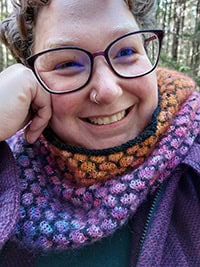 Elizabeth Stregger is an academic librarian who loves data, interesting textures, and weird neutrals. They live with their wife, Marit Munson, owner of Gobsmacked Yarn in Sackville, New Brunswick.
Pattern & images © 2026 Elizabeth Stregger