



How to Get Hooked: Information and instructions for knitters who want to learn how to crochet
INTRODUCTION
How to Get Hooked
by Julia Madill
As the new crochet columnist for Knitty, I want you to know I get it. This is KNIT-ty, not CROCHET-y! In this column, I aim to share some fun crochet tips and techniques, knowing I am primarily speaking to the unconverted: knitters. Fear not, my stick-wielding friends! I am one of you! As someone who learned to knit first, crochet second, I hope to guide you down the same path and, hopefully, remove some stumbling blocks along the way.
Knit vs Crochet: an honest comparison
If you are a knitter, (likely, given this article is in Knitty), you may be interested in learning to crochet, but find yourself wondering if you should bother. You’ve already invested the time and effort to learn one yarny craft; why learn another when the first one serves you just fine?
Well, think of it like paint: you can make equally compelling paintings using oil or watercolor, but they won’t be the same. They aren’t going to behave the same way as you're painting, either. One is not necessarily better than the other, they just possess different properties. Sometimes, you want subtle washes of watercolor, other times, thick, bold strokes of oil. It’s really all about what you’re trying to achieve with the medium.
You can make a beautiful sweater, blanket, or all manner of things with both knit or crochet. However, taking a look at what each craft does best may tip the scales in favor of one or the other, depending on your needs.
Crochet Strengths
- STABILITY Crochet can easily create dense fabric with little stretch and lots of structure great for amigurumi, baskets, or bags. It’s a common misconception that all crochet is thick and stiff. It simply isn’t true. The density of crochet fabric is stitch pattern and tension dependent, just as it is in knitting. Why is crochet better for structure, then? Where knit stitches are essentially loops, crochet stitches are a little more like knots, making them more 3-dimensional and less able to shift and stretch.
- SPEED In general, crochet is faster than knitting. Crochet stitches can vary in height dramatically, independent of hook size, where knit stitches are more or less the height of the needle you use. Taller crochet stitches mean more height achieved per row, and fewer rows overall. The result? A quicker finish.
- SHAPING Increasing and decreasing the width of your work is relatively the same in both knit and crochet. However, with crochet, you vary the height, placement and orientation of individual stitches with ease, making it simple to create waves, curves and complex shapes.
- LACE/DOILIES Creating negative space in crochet is easy, as you can simply skip a stitch without working it. To create (intentional) holes in your knitting, you typically need to work increases (yarn overs) paired with decreases: a two-step process. This hole-y simplicity, coupled with the ease of creating a crochet circle is probably why most doilies we see are crocheted, rather than knit.
- FREEFORM In crochet, there is no need to complete every row or round as every stitch is essentially finished as soon as it leaves the hook. Your next crochet stitch can be worked into the next stitch of the row, or three stitches over, or three rows down. Let’s not forget you can easily vary stitch height, create holes of all shapes and sizes and make 3-dimensional shapes that hold their own. Essentially, all of crochet’s strengths combine to make it highly suitable for winging it.
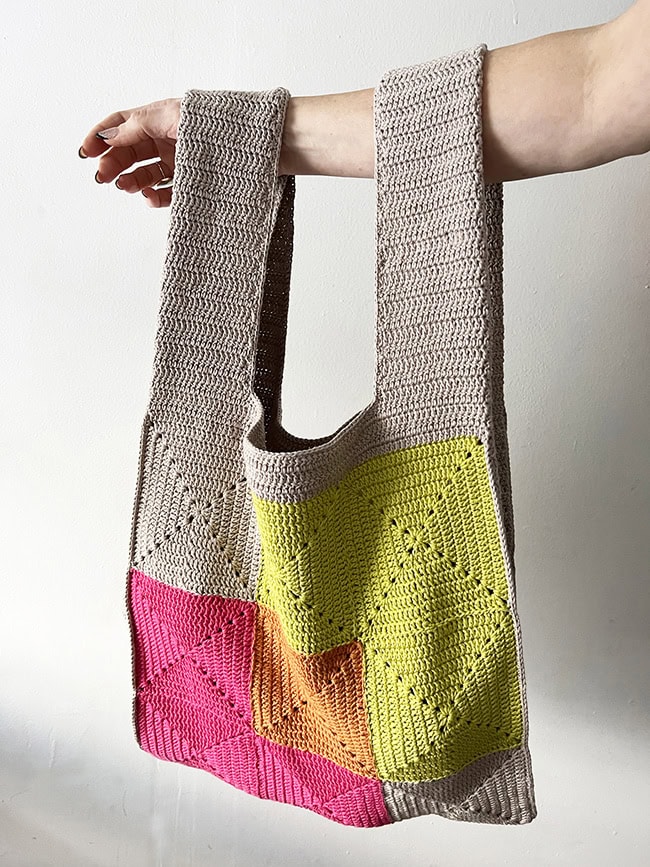
The stability of crochet fabric makes for great, strong bags that won’t stretch out of shape. Overprint Bag by Julia Madill.
Knit Strengths
- DRAPE Soft fabric with a lot of drape is often easier to achieve with knitting as opposed to crochet. As knit fabric is a series of interlocked loops, and those loops have the ability to move much better than their more knot-like crochet counterparts.
- STRETCH That same interlocked-loop business that gives us drape also provides a great ability to stretch. As a row of knit stitches is just one continuous piece of yarn looped up and down, you can pull a stitch and it will grow, borrowing some slack from its neighbours. Crochet stitches, on the other hand, are a little more locked in place, limiting their ability to stretch.
- FINE FABRIC / SMOOTHNESS In general, knit fabric is thinner than crochet fabric created with the same yarn. This is again due to the structure of knit stitches, as knit stitch loops lie fairly flat. Crochet stitches, on the other hand, are more 3-dimensional and contain loops twisted in multiple directions, resulting in a thicker, more textured fabric surface.
- STITCH READING In knitting, “live” stitches are lined up on a needle, making it a no-brainer to identify your next stitch. In crochet, your next stitch could be anywhere. This means you not only need to be able to tell one stitch from another, but also where to work into that stitch right from the get-go. “Reading” your work in this way is also an incredibly useful skill in knitting, but not necessarily essential for beginners.
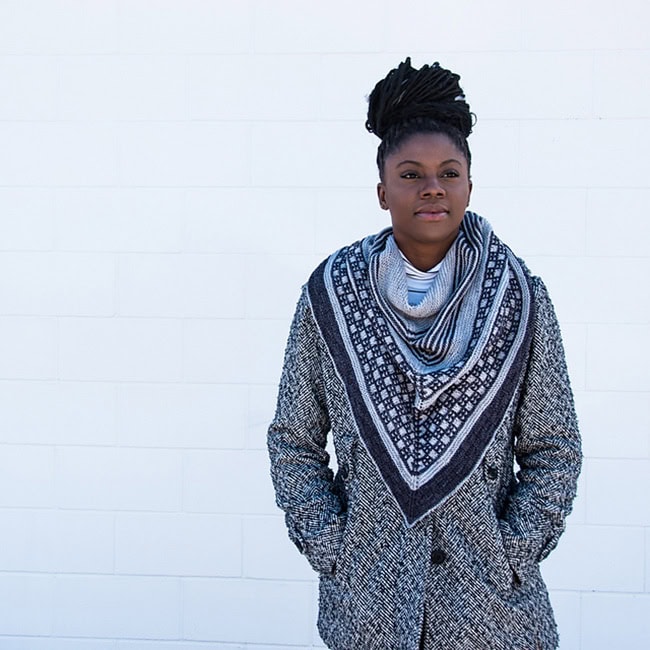
Fabric with soft drape is easy to achieve with knitting, a quality that makes for lovely shawls. Study Hall by by Sarah Schira
Crochet Weaknesses
- TEXTURED YARNS Highly textured and novelty yarns (eyelash, boucle, highly brushed) can be a nightmare to crochet. These yarns can obscure stitches, making it very difficult to figure out where to insert your hook.
- HANDED-NESS If you are a left-handed knitter (not a continental knitter, but one whose left-hand is dominant), your south-paw ways may not affect your knitting much. Lefty crocheters on the other hand, (pun deeply intended), often crochet “backwards”. Crochet rows are typically worked right-to-left, and this is quite natural when you hold your hook in your right hand. If you hold your hook in your left hand, it’s often easier to work your stitches left-to-right. Usually, this directional difference won’t affect the outcome of a project. When following a pattern, however, some challenges may arise, as it’s assumed the crocheter is working right-to-left. A lefty crocheter needs to read charts in the opposite direction, and any references to right and left need to be flipped. Also, as most instructors and content creators are right-handed, learning to crochet from righties can be a challenge for left-handed folks.
- YARN USAGE Regardless of stitch pattern, crochet will almost always use more yarn for a similar project than knitting. This is again due to the inherent structure of those knot-like crochet stitches and can’t be helped. She’s a yarn eater, and you just need to accept the healthy appetite.
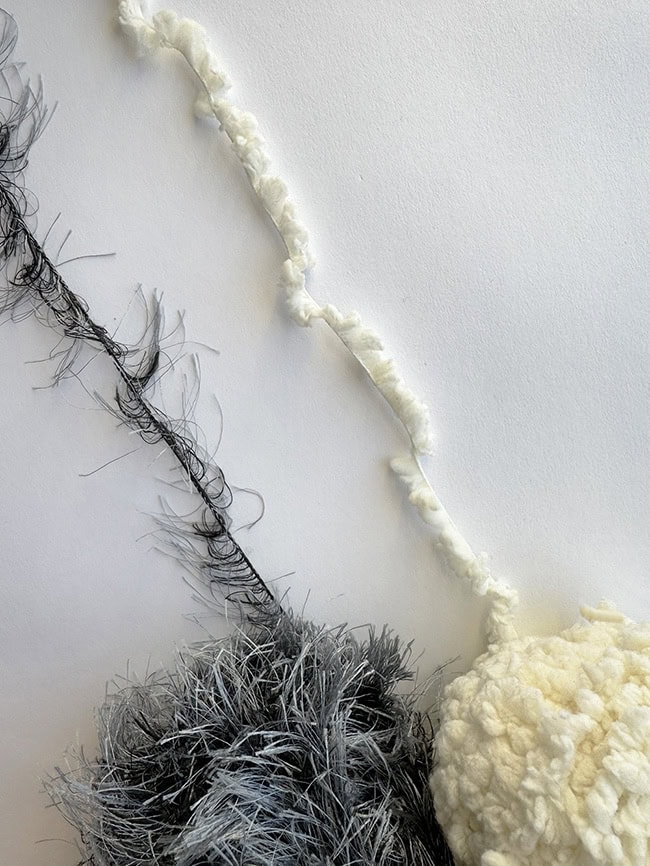
Faux fur and eyelash yarn are difficult to crochet as the texture obscures your stitches.
Knit Weaknesses
- CENTER-OUT and SMALL CIRCUMFERENCES Knitting something that requires you to begin with just a few stitches worked in the round can present a real challenge. (Top-down) hats off to those that can easily work with four stitches over a set of double-pointed needles! With just one live stitch at a time, the stitches in a round of crochet, however small, don’t need to be secured on a needle. This unencumbered nature makes it fairly easy to work small circumferences in crochet.
- NUMBER OF TOOLS Knitting needle sizes vary in both circumference and length. Add to that, your needles need to stay in a project until completion, or, all of the stitches need to be slipped to some sort of holder. The needles you need may be otherwise engaged in a U.F.O., and prompt you to purchase the same size needles again (ask me how I know). Add to that, straight needles come in pairs and double-points come in sets of 4 or 5. All together, this means a good stock of knitting needles can get quite large, and possibly expensive. In contrast, working one crochet stitch at a time means the length of the hook doesn’t need to vary and borrowing a hook from an unfinished project only requires securing a single stitch.
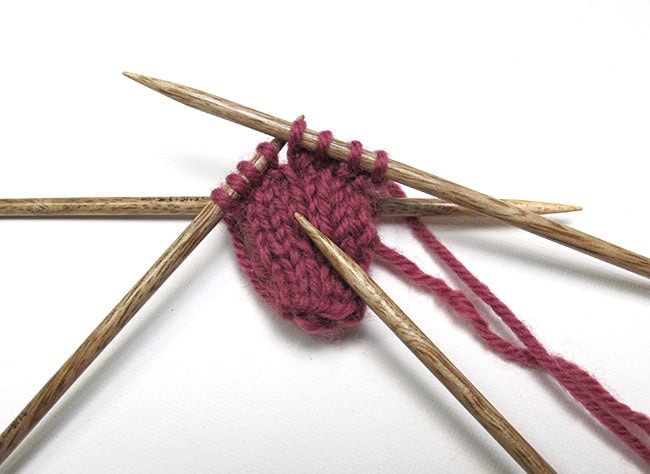
Knitting small circumferences is not always easy, but Kate Atherley has some great advice in her “Tips for Knitting Tiny Things” article in the Knitty Library.
We’ve weighed some pros and cons, but is there anything that can’t be done with one craft versus the other? In general, I will say no. Where there is a will, there is a way. That said, there are techniques that are uniquely suited to each craft, at least, in my humble opinion.
STAND-OUT CROCHET TECHNIQUES
- GRANNY SQUARES While there are a few very convincing knit stitch dupes out there, the O.G. (original granny), really can’t be beat.
- IRISH CROCHET LACE This technique is both 3-dimensional and improvisational, two big strengths of crochet.
- AMIGURUMI The ease of working small circumferences combined with great fabric structure means crochet is great for making toys.
- CORNER TO CORNER (aka C2C): This technique creates one little square of stitches at a time, and is always worked diagonally from corner to corner. With this technique, you can easily create almost any image you can chart on a square grid.
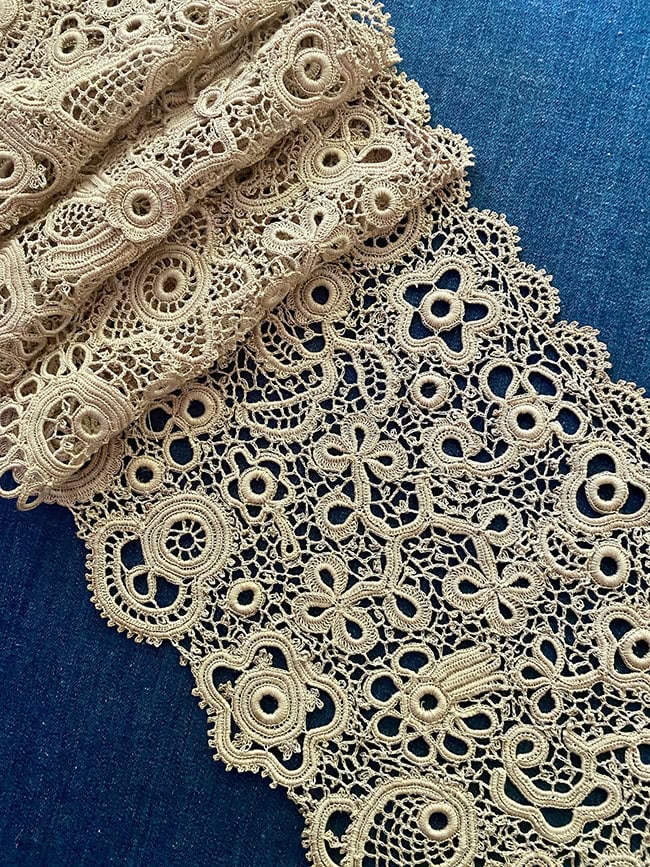
Irish crochet lace is highly improvised, joining individual motifs into a single piece of fabric with chains and picots. This antique piece of Irish Lace sold on Etsy for over $500!
STAND-OUT KNIT TECHNIQUES
- STOCKINETTE Humble stockinette a stand-out? You betcha. There are some crochet stitches that can mimic the look, but they just don’t have the same stretch, smoothness, and drape of this classic knit stitch.
- CABLES Sure you can crochet a cable, but, at least in my eyes, patterns traditionally developed in knitting, never feel quite right when replicated with crochet and vice versa.
- MACHINE KNITTING Most ready-to-wear sweaters are knit for a reason: knitting can be made on machines. As far as I am aware, there is no such machine for crochet, meaning crochet items you see in stores are either handmade or machine knit to mimic crochet (look close!).
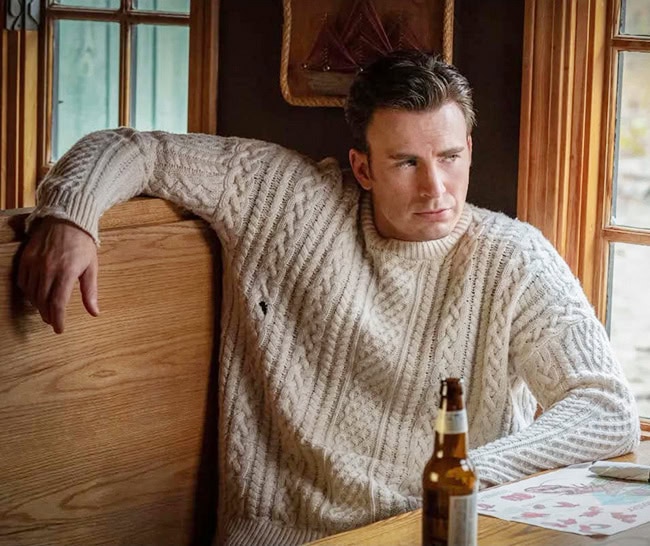
Nothing beats a classic cable-knit sweater. This one (machine knit), worn by Chris Evans in 2019’s ‘Knives Out’ had people all over the world scrambling to buy their own version of the sweater. I suppose putting Captain America in your sweater is bound to help sales.
So, dear knitter, have I convinced you to pick up a hook yet? Need more motivation? Switching between the two crafts reduces the risk of repetitive strain injuries! You’ll double the potential of your yarn stash! Think of what you can do by combining these skills! Clearly, I’m an advocate for knowing how to both knit and crochet. I’ll respect your decision should you choose to stick to your needles, but I hope I’ve helped you make an informed decision. You never know, that next project might benefit from playing a little hook-y!
ABOUT THE AUTHOR
 Julia Madill is a knit and crochet pattern designer, tech editor, and graphic artist, and Knitty's new Crochet Editor. She loves sharing what she has learned in her 10+ years of experience in the yarn industry, providing others with the tools to create in their own style, voice and aesthetic. Her book, Every Way with Granny Crochet is available from David and Charles publishers.
She lives in Toronto with her partner, two daughters, a cat named Pickles and a whole lot of yarn.
Text & images © 2025 Julia Madill