





Wiseknit™: A column that teaches you how to do things you'll find in knitting instructions
INTRODUCTION
Wiseknit™: Practical Knitting Wisdom
by Kate Atherley
One of the wonderful things about knitting is that there are so many different solutions to every problem, so many possible answers to every question. This column aims to expand your knitting knowledge and toolkit with practical solutions and answers to your technical knitting questions and conundrums.
On Brioche
Welcome to the magical world of brioche!
I absolutely love the technique, as you can create really wonderful fabrics with it – squishy and warm and drapey – and it’s a brilliant way to work with different colors or textures of yarn.
The two patterns in this issue are a great example: both are worked with the two-color technique. The Alysa scarf (coming out in the First Fall Surprise in July) uses two solid colours of the same yarn to create fascinating blended stripes, and the High Marsh Road stole uses two different textures of yarn for a really sophisticated effect.
The challenge with brioche is that the instructions are a bit of a bear. They use terms we don’t know for stitches that seem familiar, and they use familiar terms to mean very different things. Also, just to make even more fun, there’s some variation in the terms.
There are two “tricks” I recommend to knitters just beginning their brioche journeys.
Number 1: Don’t worry too much about the names/definitions of the stitches.
Number 2: Learn to read your fabric.
Number 1
There are three main stitches in brioche: there’s “create a doubled stitch”, “resolve the doubled stitch if it’s a knit” and “resolve the doubled stitch if it’s a purl”.
The last two are relatively straightforward: the first of them is brioche-knit, usually called brk (pronounced bark); and the second is brioche-purl, brp (pronounced burp – why not!). The movements for those are familiar and comfortable. They are basically k2tog and p2tog respectively, working the base stitch together with the extra strand that sits around it. We can’t call them that, however, no matter how tempting that might be, because they’re not actually decreases. Hence the new names.
The first stitch, creating a doubled stitch, is where the terminology can start to get messy. Just like yarnover/yo, there’s actually more than one version of the move, and sometimes you see different names for them, and sometimes you see the same name.
There’s two common ones, and then two much rarer ones, and they’re exactly analogous to the different flavors of yarnover. The two important ones are for when the stitches before and after are both knits, and for when the stitches before and after and both purls.
(The two rare birds are for when the stitches before and after are different – either knit followed by purl or purl followed by knit. I’ve been working and designing brioche for at least ten years, and I wrote my first pattern requiring one of those versions just this summer. You really don’t need to worry about them if you’re just starting out.)
Here’s how the process works. To create a doubled stitch, the working yarn needs to be in the front. You then slip the next stitch (purlwise, always purlwise), and take the working yarn over the needle from the front to the back, and move it into position for the next stitch.
If you’ve just worked a knit/brioche-knit, it’s a two-and-a-half-step process. The yarn is at the back; bring it to the front between the tips of the needles. Slip the next stitch purlwise. Then, in what’s barely a step let the yarn drape over the right-hand needle as you work the next (knit/brioche-knit) stitch. If you work with yarn in right hand, then the yarn gets draped over the needle as you wrap for the stitch; if you work with yarn in left hand, then you’ll move it over the right-hand needle before you knit.
Doubling a stitch between knits:
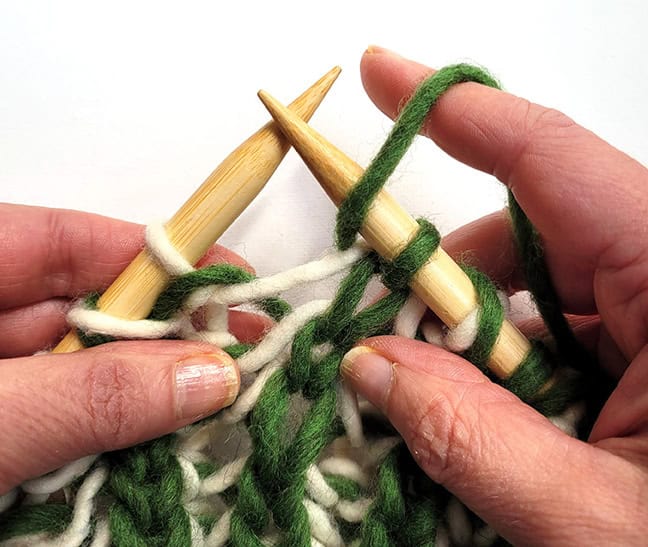
First step: Yarn has been brought to front.
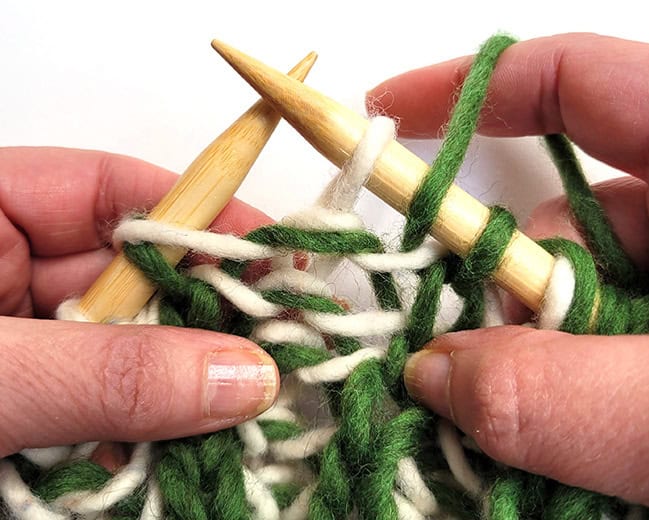
Second step: Next (single) stitch has been slipped, purlwise.
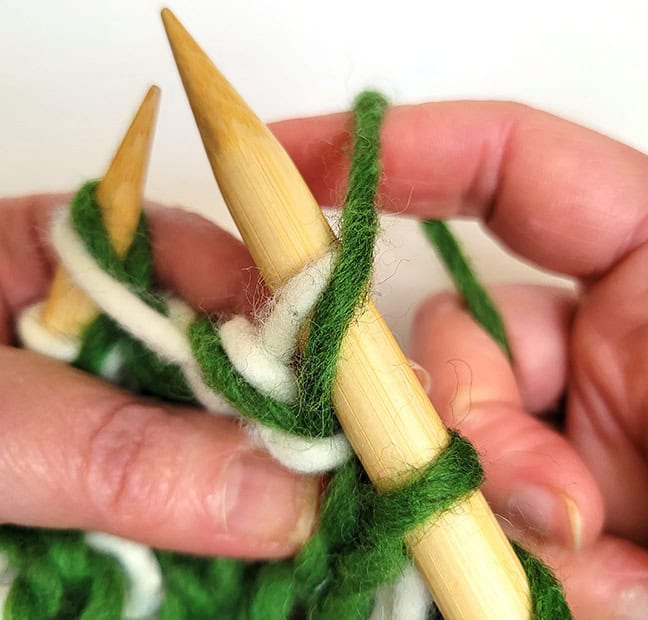
Third step: Making sure yarn is in position for next stitch, a knit/brioche knit.
If you’ve just worked a purl/brioche-purl, it’s a two-step process. The yarn is already at the front, just leave it there. Slip the next stitch purlwise. Then take the yarn all the way over the right-hand needle to the back and around to the front again, into purl position.
Doubling a stitch between purls:
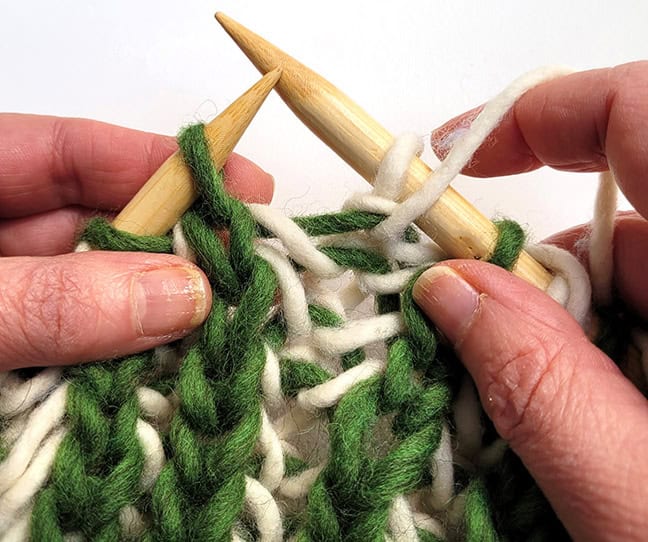
First step: Yarn sits in front already and doesn’t need to be moved.
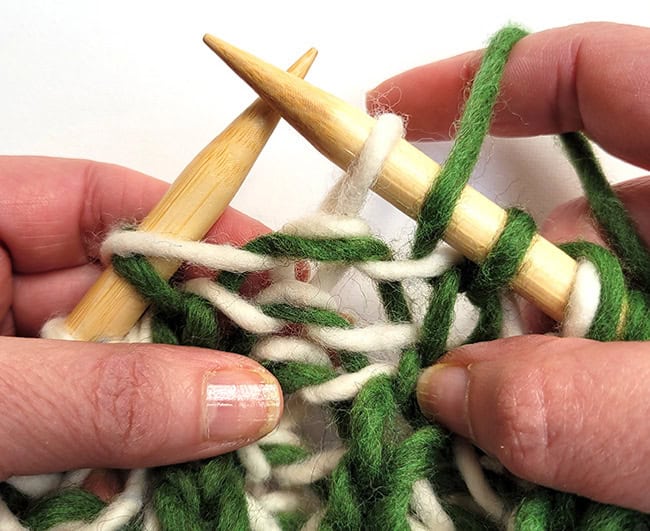
Second step: Next (single) stitch has been slipped, purlwise.
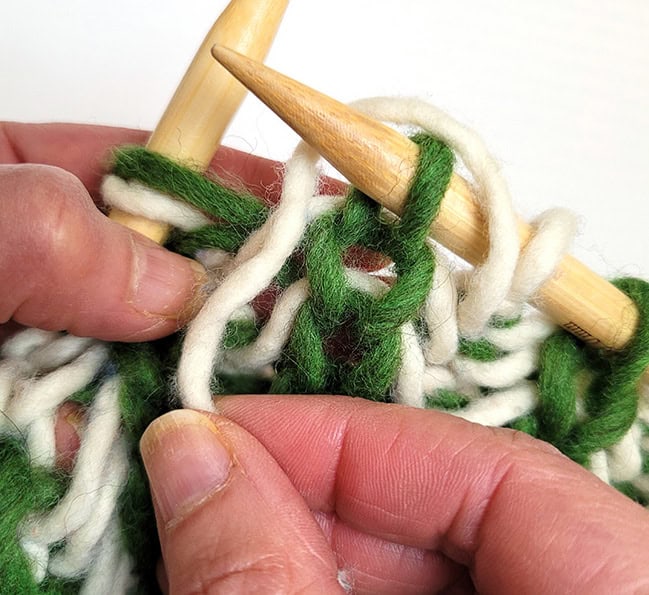
Third step: Yarn has been taken over the needle over the top and all the way back to the front again, so it’s in position for the next stitch, a purl/brioche purl.
These both create doubled stitches, which are “resolved” the next time you encounter them, by either working a brk or brp, as appropriate. That is, if it’s a knit stitch, work brioche knit, if it’s a purl stitch, work brioche purl.
As to the name of this move, “sl1yo” is pretty common, and it’s used for both situations – it’s what Knitty uses; you might also see “yfsl1” for the between-knits version and “sl1yof” for the between-purls version. Honestly, the names don’t matter – just know that you’re doubling a stitch.
Number 2
Brioche is, essentially, (k1, p1) ribbing.
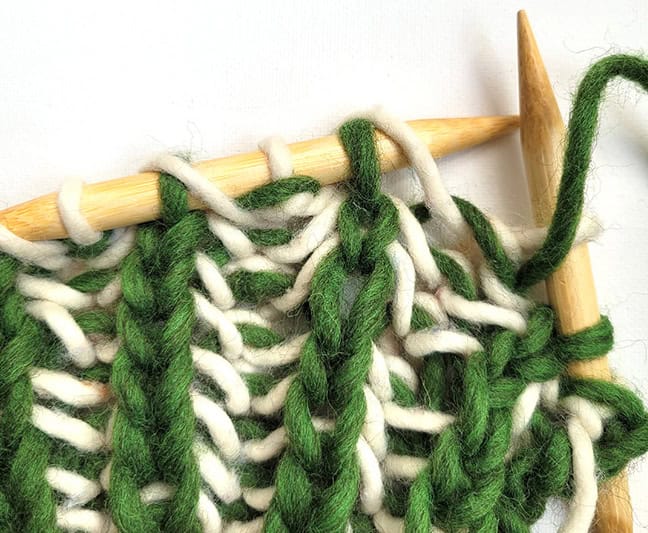
Brioche on the needles
And just like ribbing, it’s much easier to do if you just let the stitches tell you what they need, rather than trying to keep count of pattern instructions. In brioche fabrics, if the stitch presents as a knit-with-a-wrap...
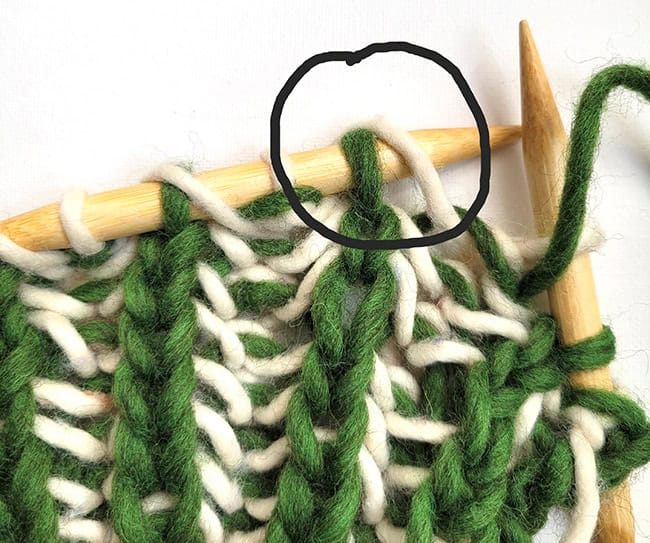 k
k
knit with a wrap
then it needs to be worked as a brioche knit. 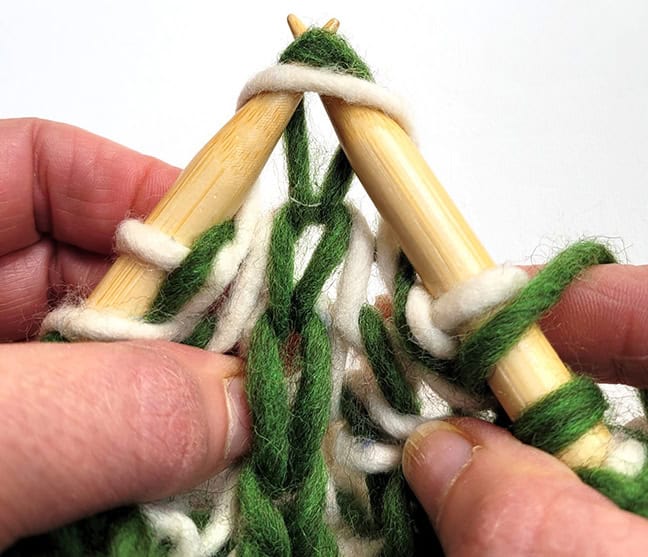
brioche knit
If the stitch presents as a purl with a wrap...
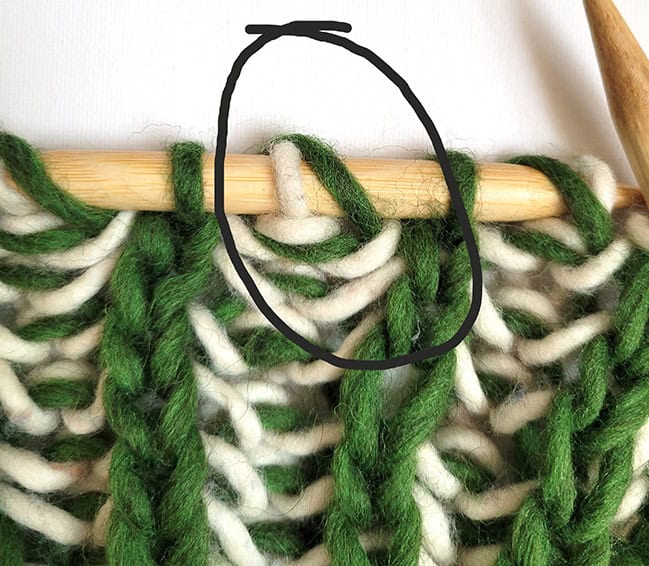
purl with a wrap
then it needs to be worked as a brioche purl.
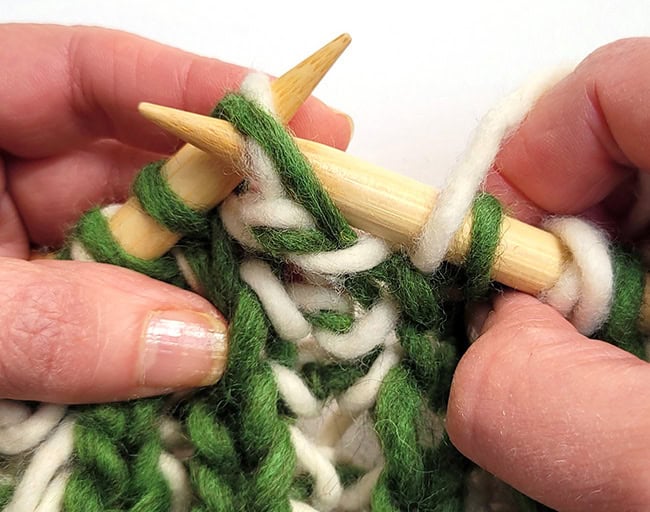
brioche purl
The knit stitches are usually easy to identify, but the purl stitches can look a little messy because of the wrap. If you’re not sure, it’s an easy process of elimination: if it’s not a knit, it’s a purl!
The other rule I like to teach is about how to work the stitches: if it’s a single, it needs to be doubled (by doing the sl1yo move), and if it’s doubled, it needs to be made single (by working either brk or brp as appropriate).
Trust me, once the pattern is established, it’s much easier to work without the instructions!
Bonus trick Number 3:
If you’re working from a charted brioche pattern, and struggling with the charts, don’t worry about it. I am normally a great fan of charts for stitch patterns, but I find the symbols for brioche charts very busy, which can make the charts hard to read. My eyes start to swim.
This is where I will do one of two things:
The quickest solution is to mark up the charts, focusing on the stitches that aren’t just “plain” brioche. In this annotated version of the chart for the High Marsh Scarf, I highlighted the stitches that break the pattern, requiring attention when knitting – in this case, the increases and the decreases (and the not-quite-in-pattern purls that you do over the increases). You can do it on paper if you like to print the charts, or digitally, in whatever app you use for viewing charts on your device.
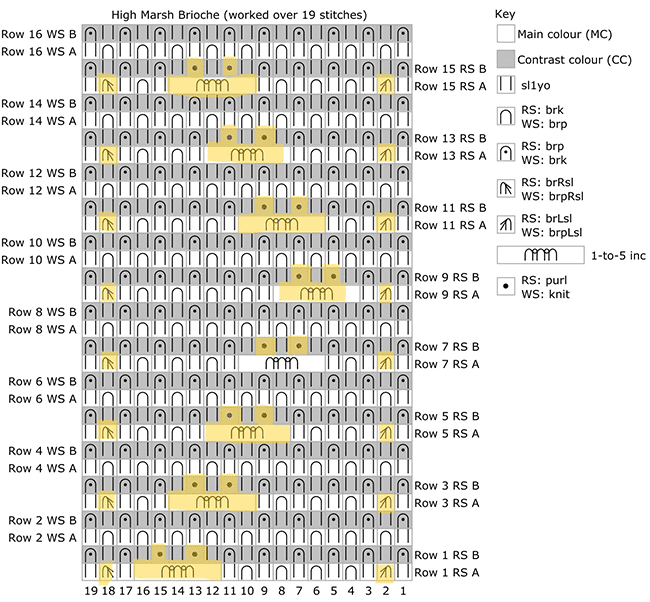
I will sometimes take one step further and create a whole new chart, in a simplified format. Once the pattern is established and you’re able to read the stitches, this simplified chart style provides all the information you need. After all, the only stitches you actually need to pay attention to are the non-standard ones – specifically the increases and decreases. In this simplified format of the chart of High Marsh, you can see clearly where the increases and decreases are placed. For example, in Row 1, you can see that the left-leaning decrease is worked in the first knit column, then there are four standard knit columns, then the increase, and the right-leaning decrease is worked in the next (and last) knit column of the 19-stitch pattern.
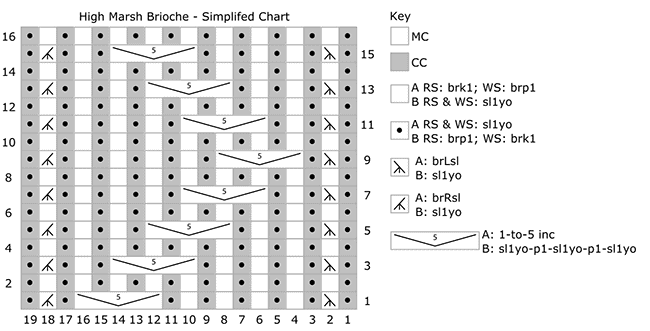
Use whichever version of the chart you prefer, or create your own annotations – or, of course, there’s always the written instructions!
ABOUT THE AUTHOR
 Kate Atherley is Knitty's Managing Technical Editor and a knitting author and teacher. The combination of her university degree in mathematics, professional experience in software development and usability, and training in garment and fashion design give her a unique perspective.
Find her new book, Math for Knitters and more of her work at kateatherley.com and on Ravelry.
Text & images © 2026 Kate Atherley.