




Wiseknit™: A column that teaches you how to do things you'll find in knitting instructions
INTRODUCTION
Wiseknit™: Practical Knitting Wisdom
by Kate Atherley
One of the wonderful things about knitting is that there are so many different solutions to every problem, so many possible answers to every question. This column aims to expand your knitting knowledge and toolkit with practical solutions and answers to your technical knitting questions and conundrums.
“BLOCK”
This word appears an awful lot in knitting patterns. You see it in gauge information, and in finishing instructions. It’s one short word that often comes without further explanation. And just like the guidance on packages of hair dye to do a skin sensitivity test before you actually use it, it’s an instruction very easily ignored.
Until you have a reaction to a hair dye, you don’t understand the value of the test. And with blocking, the ‘why’ is often missing… but it doesn't help that there’s rarely enough information about how to do it.
I’m going to answer these two questions for you, and save you from an experience as unpleasant as an allergic reaction to hair dye.
WHY
Though you may imagine blocking means taking a wet piece of knitting or crochet and pinning it in a specific shape, to specific measurements, it likely doesn’t require all that.
The first and most important part of blocking is getting the fabric you’ve made wet.
Knit fabrics change when they get wet. Stitches even out, your fabric settles. Garter stitch relaxes, ribbing smooths out, lace patterning opens up. The roll of edges gets less pronounced. Everything looks better.
The fiber you’ve used in your project changes when wet, too: Superwash wool stretches out; fluffy mohair and silk yarns loosen and lighten up; woolen-spun wools soften and relax. Cotton settles.

If you’ve not tried it, you really should. If you’re making two of something – socks, mitts, sleeves – “block” one and not the other and compare. Even if it’s only a single item, take photos of the thing before the “block”, and after. You’ll find a remarkable difference. The blocked one looks neater and better knitted.
“Blocking” is also important to get things clean. I have a dog, I drink and spill a lot of non-clear beverages like black coffee and diet Coke, and enjoy snacking. All sorts of stuff finds its way onto my hands and my yarn as I’m working.
Cleaning the fabric matters for two reasons. The first: I don’t love giving a baby sweater as a gift if I’ve spilled beer on it. The second is moths.
Yes, moths.
Moths respond to wool the way humans respond to a bakery: we’re significantly more likely to be interested if there’s a nice aroma coming through the open door. But the aromas that moths are after aren’t fresh cookies – they’re after the scents of the stuff that humans leave on the wool. Moths enjoy discarded hair and skin cells, the oils off your hair and skin, and scraps of food. If we want to reduce the risk of our woollies being attractive to, and therefore savaged by, moths we need to wash them periodically – most importantly before we put them away in the spring.
HOW
Step 1: Wash
Wash the item the way you’ll wash it to take care of it.
- MACHINE WASH: Use cold water, and as gentle a cycle as possible. Heat can cause dye to run or fade. (“Color-catcher” sheets do work well, if you’re not sure!)
Be careful about the washing product you’re using. Laundry detergents that have stain fighters in them can be a problem. Products like Oxi-Clean use enzymes to break down proteins. This is great if you’ve spilled gravy on a cotton t-shirt, but wool, silk, and other animal fibers are themselves proteins. A stain-fighting detergent may well be damaging your yarn. Choose a very gentle washing product; best of all, one that’s marked as safe for wool.

- HANDWASH: Soak your knit in lukewarm water with an appropriate wool wash for 15-20 minutes. Then either roll it in a towel and squeeze hard to get most of the moisture out, or use your washing machine’s spin cycle. Yes, really! A high-speed spin in remarkably gentle: the centrifugal force holds anything in place against the drum, so there’s no agitation. You can put pieces in a mesh washing bag if you like. I use the spin cycle for even my most delicate hand-wash only fabrics. Just make sure you’re using the right setting on your machine and don’t add other items that might pull or snag your project. You don’t want a rinse and spin, select spin only (sometimes labelled as drain and spin), and always use the highest-available speed.

Step 2: Let it Dry
The answer for 95% of your knit and crochet fabrics is to lay the piece flat to dry. Do not stretch or pin the fabrics, just lay them flat to dry. Let the fabric relax to its natural shape and size.
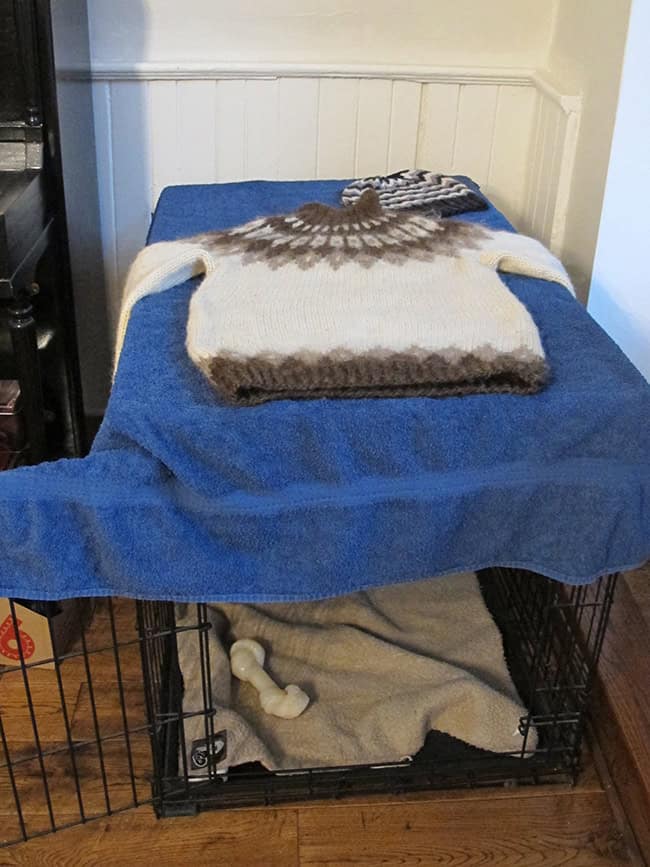
Why shouldn't you stretch?
Depending on the yarn you’re using, it’s either going to make extra work for you, or it’s going to not work at all.
There are two types of fibers that we work with: ones that have stretch and memory, and ones that don’t. Wool has the wonderful ability to stretch when it’s wet and remember that position; if you pin out a piece a wool fabric to dry, it will hold that shape and size. We take advantage of this when making lace shawls. We stretch the fabric to open up the yarnovers and tidy up the lines, to enhance curves and scalloped edges, to make the fabric look its best.
Unfortunately, when you wash it again, that stretch gets forgotten. So if you’re knitting with wool and wool-majority blends, and if you stretch and pin the fabric to bring it to the shape or size you need, you’ll have to do that every time you wash it.
On the other hand, a lot of the yarns we work with have no memory: cotton, linen, hemp, and synthetics being the key examples. You can absolutely stretch out a fabric made in cotton yarn when wet, but when dry and unpinned it will shrink back to its original size. To take advantage of this characteristic of plant fibers, pop it in the dryer till it's almost fully dry, then lay it flat to finish drying. If you do this with your swatch before making the thing, and use the measurements from this finished, blocked, and dried swatch to guide you, the tumble almost-dry will become part of the care that keeps your garment the size it was when you finished knitting it.
This is why gauge is always listed as being measured after blocking, and why you should wash – “block” – your swatches the way you'll wash your garment.
But what about "pin to measurements" in some pattern blocking instructions? If after washing, the item is too small, and you want to be able to stretch and pin your item to a specific size… well, if it’s made of wool you can do it but you’re making a lifetime of work for yourself; and if it’s not, then it’s a fruitless task.
So unless it’s a lace shawl made out of wool or other animal fibers (including silk), then the answer is easy: Wash and lay flat to dry. For a lace shawl made out of cotton, linen or hemp, you can neaten the fabric and tidy up the stitches by washing as described above, then stretching and pinning the piece out. But note that there's a crucial difference here: the washing helps tidy the stitches, but doesn't change the size or shape of the piece. Pinning just helps the tidying stay put as it dries.
For items that are worn with negative ease – items that stretch to fit like socks and hats – it’s crucially important that you don’t stretch them in drying. If you make them larger than they are supposed to be, you are taking away their ability to hold their fit, for the sock leg to stay up, for the hat to stay on your head in a stiff breeze. Sock blockers are an excellent tool for gorgeous project photography, but they don’t belong in your laundry room. I never use them.

This is how I dry my handknit socks.
There are fabrics that might need a bit more help once dry. Stranded colorwork, in particular, can be a little bit bumpy and uneven, even after a wash. It’s important to note that this is not a sign you’re doing anything wrong! Generally, I find that if a knitter’s stranded colorwork fabric is smooth and tidy on the needles, it’s a sign that they are working too tight.
For these types of projects, I recommend smoothing the wet fabric out when laying it to dry, shaping it a little by hand. Then after it’s dry, use a hand-held steamer or even just an iron with the steam button held down to tidy it up further. (It’s useful to note here that steaming only works with wool, other animal fibers, and synthetics. Steaming cotton doesn’t do a thing.)
And if it’s a lace shawl, then yes, absolutely: these are worth the stretching and pinning. These are the projects that need blocking wires and mats and pins. We stretch them out so that they’re as big as possible and so that the lacework is tidy and beautiful. It’s worth it so you can show off your efforts, and because you don’t need to wash shawls very often. Theresa wrote a column on blocking lace shawls back in 2011 that's very helpful.
In Knitty patterns more recently, rather than just saying “block”, we have started spelling out the details to guide you. Although, really, unless it’s a lace shawl, the answer is simple: wash and lay flat to dry!
WHEN
Always do the wash before any finishing tasks – before seaming, before weaving in ends, before working any necklines or picked-up edgings. Bring the fabric to its finished shape and size, settle it and smooth it. These finishing tasks are easier on a tidy fabric! (And no, the edges don’t need to be perfectly flat for sewing up.)
On weaving in ends: Because I’m utterly shameless about using cast-on and bind off tails to do any required seaming, I always wait until after that final wash to weave things in. Leaving the tails out also means that if you discover something needs adjusting, it’s more easily undone. And perhaps most importantly, you get better results if you weave your ends into the settled fabric; weaving into a fabric before it’s washed can result in puckers or visible ends.
In short: All projects need to be blocked, but it really is almost always as simple as a wash. You’ll be so much happier with the results!
ABOUT THE AUTHOR
 Kate Atherley is Knitty's Managing Technical Editor and a knitting author and teacher. The combination of her university degree in mathematics, professional experience in software development and usability, and training in garment and fashion design give her a unique perspective. Her new book, Math for Knitters, has just been released.
You can see more of her work at kateatherley.com and on Ravelry.
Text & images © 2026 Kate Atherley.