



Trapeziate, a free knitting pattern from Knitty.com.
INTRODUCTION
Trapeziate

by Kate Harvie

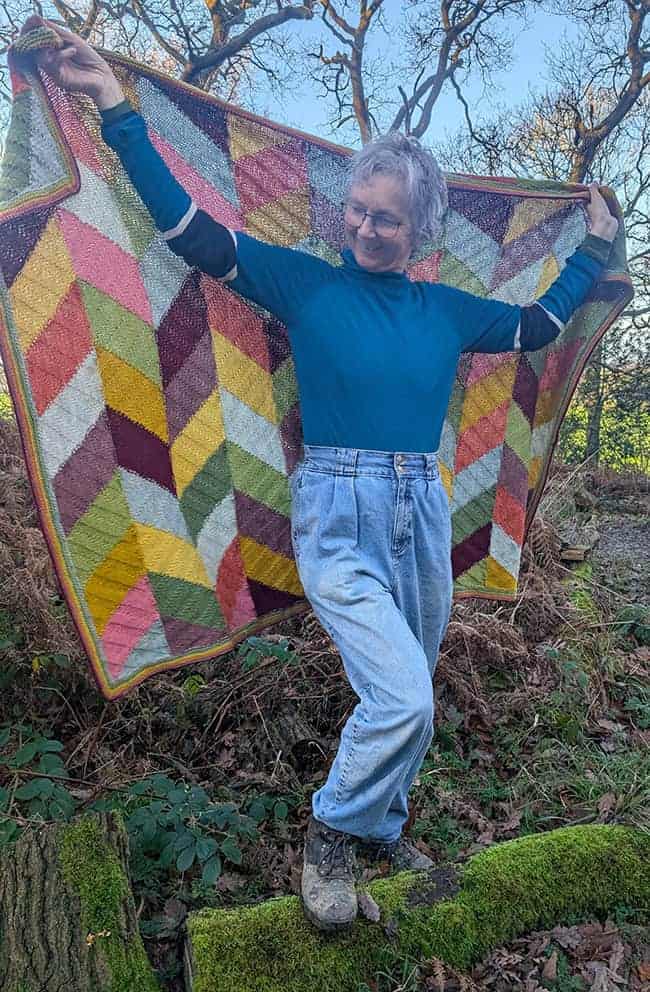
I knitted this blanket/wrap for my new granddaughter, and my intention is for it to be a heirloom, but that’s up to her! It could be used as a wrap on a chilly summer evening, or a lap blanket for granny, or a playmat, or anything else you want really. The blanket is reversible.
My blanket used almost every scrap of 10 100g skeins of hand-dyed DK yarn. You could do what I did and use 10 skeins of the same yarn, or you could make a scrappy blanket and use up random balls of similar yarn. It would work in any yarn weight, and you can make just about any size by varying the number of shapes in each row and the number of repeats of the shapes.
It looks a lot more complicated than it actually is; once you get going the pattern becomes quite intuitive.
 model: Kate Harvie
photos: Rachel Harvie



SIZE
One
FINISHED MEASUREMENTS
Width: 41 inches/104 cm
Length: 60 inches/152 cm
MATERIALS
Yarn
World of Wool Santorini DK: [100% superwash merino wool, 252 yds/230 metres per 100g skein]. This yarn is sold undyed, and was dyed by me using natural dyes. I used 10 skeins which were dyed as follows:
[Color A]: Blue, dyed with woad, 1 skein.
[Color B]: Green, dyed with common reed (Phragmites australis), 1 skein.
[Color C]: Dark purple/red, dyed with cochineal, 1 skein.
[Color D]: Yellow, dyed with dyer’s greenweed (Genista tinctoria) and dyer’s chamomile (Anthemis tinctoria), 1 skein.
[Color E]: Orange, dyed with madder, 1 skein.
[Color F]: Light blue, dyed with woad, 1 skein.
[Color G]: Purple, dyed with Oakmoss lichen (Evernia prunastri), 1 skein.
[Color H]: Light green, dyed with common reed (Phragmites australis), 1 skein.
[Color J]: Gold, dyed with dyer’s greenweed (Genista tinctoria) and dyer’s chamomile (Anthemis tinctoria), 1 skein.
[Color K]: Pink, dyed with cochineal and madder, 1 skein.
OR
Stylecraft Special DK: [100% premium acrylic, 323 yds/295m per 100g ball];
[Color A]: 2179 Nigella, 1 ball.
[Color B]: 1116 Green, 1 ball.
[Color C]: 1123 Claret, 1 ball.
[Color D]: 1263 Citron, 1 ball.
[Color E]: 1723 Tomato, 1 ball.
[Color F]: 2186 Blue Sky, 1 ball.
[Color G]: 1828 Boysenberry, 1 ball.
[Color H]: 1821 Grass Green, 1 ball.
[Color J]: 1709 Gold, 1 ball.
[Color K]: 1241 Fondant, 1 ball.
OR
West Yorkshire Spinners Colour Lab DK: [100% UK machine washable wool, 246 yds/225m per 100g ball];
[Color A]: Electric Blue, 1 ball.
[Color B]: Bottle Green, 1 ball.
[Color C]: Crimson Red, 1 ball.
[Color D]: Citrus Yellow, 1 ball.
[Color E]: Coral Crush, 1 ball.
[Color F]: Sky Blue, 1 ball.
[Color G]: Perfectly Plum, 1 ball.
[Color H]: Aqua Green, 1 ball.
[Color J]: Zesty Orange, 1 ball.
[Color K]: Candy Pink, 1 ball
Yarn Characteristics
The sample is made in a hand-dyed superwash wool with 3 plies and a round profile. The pattern will look best worked in solid or slightly heathered colours.
The project used almost all of the yardage. If you are making a substitution, it really works best with 10 different colors.
Recommended needle size
[always use a needle size that gives you the gauge listed below - every knitter's gauge is unique]
US 6/4mm long circular needle, at least 32 inches/80cm long, but you will find it easier with a longer needle, especially as your blanket gets bigger. A needle 60 inches/150cm long will be ideal if you have one.
Additional circular needle of the same size may be needed to accommodate all the stitches when working the border.
Notions
yarn needle
scale (optional)
GAUGE
22 sts/28 rows = 4 inches/10 cm in stockinette stitch
20 sts/30 rows = 4 inches/10 cm in pattern stitch
Gauge is not critical in this project but working at a different gauge will result in a different finished item and will change yardage requirements. As this pattern uses all your yarn, if in doubt err on the side of a tighter gauge, so you will have enough yarn to work your border.
Superwash yarn may stretch when washed and this is more likely if your piece is large, so your swatch may stretch less than your finished item. This can be helped by drying the blanket on a gentle setting. Iif you don't have a dryer, remove as much water as possible by rolling your item in towels, then gently spread on a flat surface and pat it into the smallest dimensions you can achieve without causing folds. Leave to dry completely then spread out gently without stretching before measuring.
PATTERN NOTES
[Knitty's list of standard abbreviations and techniques can be found here.]
Construction method:
The centre of the blanket is worked flat. The cast-on forms the first short edge. The colored blocks are worked in sections, which are joined as you go using intarsia. Each section contains 9 trapezius shapes of different colors and two triangles which are worked in the same color. The patterns slope in opposite directions in each section.
After working 11 sections, stitches are picked up around the blanket edges to work the border in the round, using up as much of the remaining yarn as possible.
Color selection:
The blanket as described in these instructions is worked in 10 different colors which are arranged in a semi-random sequence.
For variations on this blanket, you could use fewer colors, or you could keep the same color order in each section (this would save a lot of sewing in of ends). You can make the blanket larger or smaller by varying the number of shapes in each section and the number of sections. There are more than 3.5 million possible orders in which 10 colors can be placed, so you do not need to follow my sequence of colors if you don’t want to.
Notes:
Although this blanket is reversible, RS and WS are not identical. You may find it helpful to mark the RS with a safety pin or similar to avoid confusion. You will have to work a couple of rows first.
The first and last stitches of every row are always knit. This makes a neat edge for picking up stitches to work the border. When picking up stitches, pass your needle through the middle of the edge stitch, as this will make your pick up neat on the WS.
On each RS row the colors shift by one stitch in one direction and the knit and purl pattern shifts by one stitch in the opposite direction.
The triangles at the ends of each section are worked in the same color. If you have center-pull balls, you can work one triangle from each end of the same ball of yarn.
Blanket size:
Each trapezius or triangle shape measures 10cm across the base and is 13cm high. You can vary the size by adding or subtracting shapes.
Intarsia: Twist your yarns together every time you change color on every row to avoid holes. The new color should be brought below and to the right of the old color. Because you have a large number of balls of yarn in use at once, it is important to ensure your yarns are untangled after every WS row. If you have the space, the easiest way to avoid tangles is to use center-pull balls and place your yarns on the floor or the table in order in front of you. When you work RS rows, your yarns will be twisted, but these should untwist when working WS rows. Most of the time it is obvious where to twist the yarns, but in case it is not, I have given advice below:
Advice on twisting colors row by row:
Odd numbered sections:
Row 1: You won’t twist on this row if you have started new colors.
Row 2: Take old color to back, twist at back. Untwist after you have completed the row.
Rows 3, 13, 23, 33: Work to last st of old color, sl next st, bring new color to front, sl st back to LH needle, twist at front.
Rows 4, 14, 24, 34: Twist at back.
Rows 5, 15, 25, 35: Twist at front.
Rows 6, 16, 26, 36: Twist at back.
Rows 7, 17, 27, 37: Work to last st of old color, sl next st, take new color to back, sl st back to LH needle, twist at back.
Rows 8, 18, 28, 38: Twist at front.
Rows 9, 19, 29, 39: Twist at back.
Rows 10, 20, 30, 40: Twist at front.
Rows 11, 21, 31: Take old color to back, twist at back.
Rows 12, 22, 32: Twist at front, then take new color to back.
Even numbered sections:
Row 1: You won’t twist on this row if you have started new colors.
Rows 2, 12, 22, 32: Bring old color forward, twist at front. Untwist after you have completed row 2.
Rows 3, 13, 23, 33: Work to last st of old color, bring new forward, twist at front.
Rows 4, 14, 24, 34: Twist at back.
Rows 5, 15, 25, 35: Twist at front.
Rows 6, 16, 26, 36: Twist at back.
Rows 7, 17, 27, 37: Work to last st of old color, take both yarns to back, twist at back.
Rows 8, 18, 28, 38: Twist at front.
Rows 9, 19, 29, 39: Twist at back.
Rows 10, 20, 30, 40: Twist at front.
Rows 11, 21, 31: Twist at back, bring new forward.
CHARTS
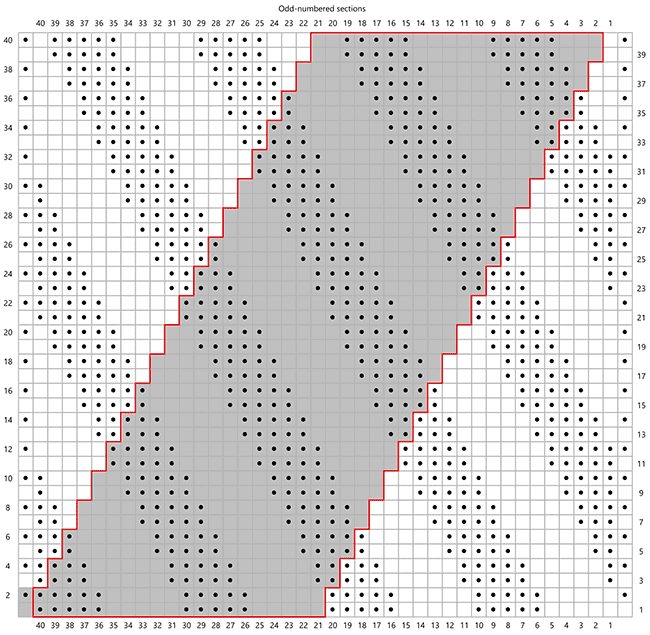

Odd-numbered Section Pattern
Note: In Odd-numbered sections, the color change moves one stitch to the right on each RS row, and the knit and purl pattern moves one stitch to the left.
Row 1 [RS]: With first color as indicated, K1, (k5, p5) twice; [with the next color, (k5, p5) twice] 9 times across, k1 with the last color.
Row 2 [WS]: With last color, K1, (k5, p5) twice, [with the next color, (k5, p5) twice] 9 times across, k1 with first color.
Row 3: With first color, k1, p1, k5, p5, k5, p3, [with the next color, p2, k5, p5 k5, p3] 9 times across; with a separate ball of first color, p1, k1. Colors have shifted one stitch to the right, and the knit and purl pattern has shifted one stitch to the left.
Row 4: With first color k2, [with the next color k3, p5, k5, p5, k2] 10 times across.
Row 5: With first color k1, p2, k5, p5, k5, p1, [with the next color p4, k5, p5, k5, p1] 9 times across, with first color p2, k1.
Row 6: With first color k3, [with the next color k1, p5, k5, p5, k4] 9 times across, with first color k1, p5, k5, p5, k3.
Row 7: With first color k1, p3, k5, p5, k4, [with the next color k1, p5, k5, p5, k4] 9 times across, with first color k1, p2, k1.
Row 8: With first color k3, p1, [with the next color p4, k5, p5, k5, p1] 9 times across, with first color p4, k5, p5, k4.
Row 9: With first color k1, p4, k5, p5, k2, [with next color k3, p5, k5, p5, k2] 9 times across, with first color k3, p1, k1.
Row 10: With first color k2, p3, [with next color p2, k5, p5, k5, p3] 9 times across, with first color p2, k5, p5, k5.
Row 11: With first color k1, p5, k5, p5, [with next color (k5, p5) twice] 9 times across, with first color k6.
Row 12: With first color k1, p5, [with next color (k5, p5) twice] 9 times, with first color k5, p5, k6.
Row 13: With first color k2, p5, k5, p3, [with next color p2, k5, p5, k5, p3] 9 times, with first color p2, k5.
Row 14: With first color k1, p4, k2, [with next color k3, p5, k5, p5, k2] 9 times, with first color k3, p5, k5, p1, k1.
Row 15: With first color k3, p5, k5, p1, [with next color p4, k5, p5, k5, p1] 9 times, with first color p4, k4.
Row 16: With first color k1, p3, k4, [with next color k1, p5, k5, p5, k4] 9 times, with first color k1, p5, k5, p2, k1.
Row 17: With first color k4, p5, k4, [with next color k1, p5, k5, p5, k4] 9 times, with first color k1, p5, k3.
Row 18: With first color k1, p2, k5, p1, [with next color p4, k5, p5, k5, p1] 9 times, with first color p4, k5, p3, k1.
Row 19: With first color k5, p5, k2, [with next color k3, p5, k5, p5, k2] 9 times, with first color k3, p5, k2.
Row 20: With first color k1, p1, k5, p3, [with next color p2, k5, p5, k5, p3] 9 times, with first color p2, k5, p4, k1.
Row 21: With first color k6, p5, [with next color (k5, p5) twice] 9 times, with first color k5, p5, k1.
Row 22: With first color k6, p5, [with next color (k5, p5) twice] 9 times, with first color k5, p5, k1.
Row 23: With first color k1, p1, k5, p3, [with next color p2, k5, p5, k5, p3] 9 times, with first color p2, k5, p4, k1.
Row 24: With first color k5, p5, k2, [with next color k3, p5, k5, p5, k2] 9 times, with first color k3, p5, k2.
Row 25: With first color k1, p2, k5, p1, [with next color p4, k5, p5, k5, p1] 9 times, with first color p4, k5, p3, k1.
Row 26: With first color k4, p5, k4, [with next color k1, p5, k5, p5, k4] 9 times, with first color k1, p5, k3.
Row 27: With first color k1, p3, k4, [with next color k1, p5, k5, p5, k4] 9 times, with first color k1, p5, k5, p2, k1.
Row 28: With first color k3, p5, k5, p1, [with next color p4, k5, p5, k5, p1] 9 times, with first color p4, k4.
Row 29: With first color k1, p4, k2, [with next color k3, p5, k5, p5, k2] 9 times, with first color k3, p5, k5, p1, k1.
Row 30: With first color k2, p5, k5, p3, [with next color p2, k5, p5, k5, p3] 9 times, with first color p2, k5.
Row 31: With first color k1, p5, [with next color (k5, p5) twice] 9 times, with first color k5, p5, k6.
Row 32: With first color k1, p5, k5, p5, [with next color (k5, p5) twice] 9 times, with first color k6.
Row 33: With first color k2, p3, [with next color p2, k5, p5, k5, p3] 9 times, with first color p2, k5, p5, k5.
Row 34: With first color k1, p4, k5, p5, k2, [with next color k3, p5, k5, p5, k2] 9 times, with first color k3, p1, k1.
Row 35: With first color k3, p1, [with next color p4, k5, p5, k5, p1] 9 times, with first color p4, k5, p5, k4.
Row 36: With first color k1, p3, k5, p5, k4, [with next color k1, p5, k5, p5, k4] 9 times, with first color k1, p2, k1.
Row 37: With first color k3, [with next color k1, p5, k5, p5, k4] 9 times, with first color k1, p5, k5, p5, k3.
Row 38: With first color k1, p2, k5, p5, k5, p1, [with next color p4, k5, p5, k5, p1] 9 times, with first color p2, k1.
Row 39: With first color k2, [with next color k3, p5, k5, p5, k2] 9 times, with first color k3, p5, k5, p5, k2.
Row 40: With first color k1, p1, k5, p5, k5, p3, [with next color p2, k5, p5, k5, p3] 9 times, with first color p1, k1.
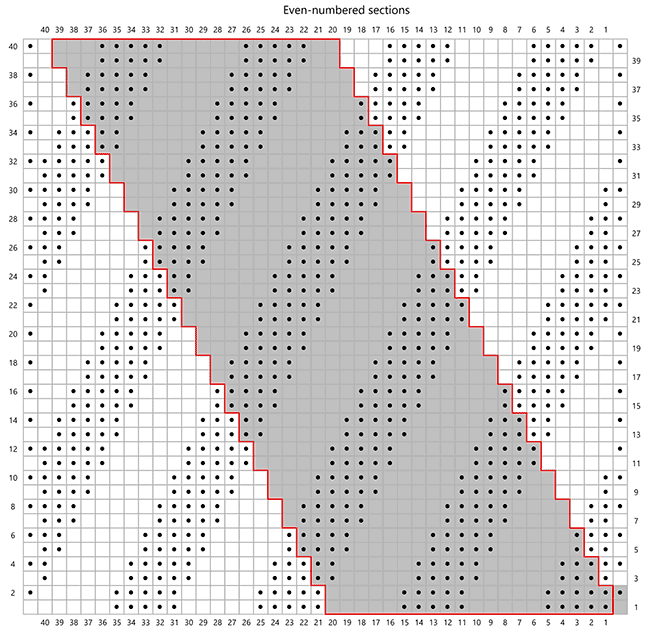
Even-numbered Section Pattern
Note: In Even-numbered sections, the color change moves one stitch to the left on each RS row, and the knit and purl pattern moves one stitch to the right.
Row 1: [RS] With first color as indicated k1, (p5, k5) twice; [with the next color (p5, k5) twice] 9 times across, k1 with the last color.
Row 2: [WS] With last color k1, (p5, k5) twice, [with next color (p5, k5) twice] 9 times, k1 with first color.
Row 3: With a separate ball of last color k1, p1, [with next color p3, k5, p5, k5, p2] 9 times, with last color p3, k5, p5, k5, p1, k1.
Row 4: With last color k2, p5, k5, p5, k3, [with next color k2, p5, k5, p5, k3] 9 times, with last color k2.
Row 5: With last color k1, p2, [with next color p1, k5, p5, k5, p4] 9 times, with last color p1, k5, p5, k5, p2, k1.
Row 6: With last color k3, p5, k5, p5, k1, [with next color k4, p5, k5, p5, k1] 9 times, with last color k3.
Row 7: With last color k1, p2, k1, [with next color k4, p5, k5, p5, k1] 9 times, with last color k4, p5, k5, p3, k1.
Row 8: With last color k4, p5, k5, p4, [with next color p1, k5, p5, k5, p4] 9 times, with last color p1, k3.
Row 9: With last color k1, p1, k3, [with next color k2, p5, k5, p5, k3] 9 times, with last color k2, p5, k5, p4, k1.
Row 10: With last color k5, p5, k5, p2, [with next color p3, k5, p5, k5, p2] 9 times, with last color p3, k2.
Row 11: With last color, k6, [with next color (p5, k5) twice] 9 times, with last color p5, k5, p5, k1.
Row 12: With last color k6, p5, k5, [with next color (p5, k5) twice] 9 times, with last color p5, k1.
Row 13: With last color k5, p2, [with next color p3, k5, p5, k5, p2] 9 times, with last color p3, k5, p5, k2.
Row 14: With last color k1, p1, k5, p5, k3, [with next color k2, p5, k5, p5, k3] 9 times, with last color k2, p4, k1.
Row 15: With last color k4, p4, [with next color p1, k5, p5, k5, p4] 9 times, with last color p1, k5, p5, k3.
Row 16: With last color k1, p2, k5, p5, k1, [with next color k4, p5, k5, p5, k1] 9 times, with last color k4, p3, k1.
Row 17: With last color k3, p5, k1, [with next color k4, p5, k5, p5, k1] 9 times, with last color k4, p5, k4.
Row 18: With last color k1, p3, k5, p4, [with next color p1, k5, p5, k5, p4] 9 times, with last color p1, k5, p2, k1.
Row 19: With last color k2, p5, k3, [with next color k2, p5, k5, p5, k3] 9 times, with last color k2, p5, k5.
Row 20: With last color k1, p4, k5, p2, [with next color p3, k5, p5, k5, p2] 9 times, with last color p3, k5, p1, k1.
Row 21: With last color k1, p5, k5, [with next color (p5, k5) twice] 9 times, with last color p5, k6.
Row 22: With last color k1, p5, k5, [with next color (p5, k5) twice] 9 times, with last color p5, k6.
Row 23: With last color k1, p4, k5, p2, [with next color p3, k5, p5, k5, p2] 9 times, with last color p3, k5, p1, k1.
Row 24: With last color k2, p5, k3, [with next color k2, p5, k5, p5, k3] 9 times, with last color k2, p5, k5.
Row 25: With last color k1, p3, k5, p4, [with next color p1, k5, p5, k5, p4] 9 times, with last color p1, k5, p2, k1.
Row 26: With last color k3, p5, k1, [with next color k4, p5, k5, p5, k1] 9 times, with last color k4, p5, k4.
Row 27: With last color k1, p2, k5, p5, k1, [with next color k4, p5, k5, p5, k1] 9 times, with last color k4, p3, k1.
Row 28: With last color k4, p4, [with next color p1, k5, p5, k5, p4] 9 times, with last color p1, k5, p5, k3.
Row 29: With last color k1, p1, k5, p5, k3, [with next color k2, p5, k5, p5, k3] 9 times, with last color k2, p4, k1.
Row 30: With last color k5, p2, [with next color p3, k5, p5, k5, p2] 9 times, with last color p3, k5, p5, k2.
Row 31: With last color, k6, p5, k5, [with next color (p5, k5) twice] 9 times, with last color p5, k1.
Row 32: With last color k6, [with next color (p5, k5) twice] 9 times, with last color p5, k5, p5, k1.
Row 33: With last color k5, p5, k5, p2, [with next color p3, k5, p5, k5, p2] 9 times, with last color p3, k2.
Row 34: With last color k1, p1, k3, [with next color k2, p5, k5, p5, k3] 9 times, with last color k2, p5, k5, p4, k1.
Row 35: With last color k4, p5, k5, p4, [with next color p1, k5, p5, k5, p4] 9 times, with last color p1, k3.
Row 36: With last color k1, p2, k1, [with next color k4, p5, k5, p5, k1] 9 times, with last color k4, p5, k5, p3, k1.
Row 37: With last color k3, p5, k5, p5, k1, [with next color k4, p5, k5, p5, k1] 9 times, with last color k3.
Row 38: With last color k1, p2, [with next color p1, k5, p5, k5, p4] 9 times, with last color p1, k5, p5, k5, p2, k1.
Row 39: With last color k2, p5, k5, p5, k3, [with next color k2, p5, k5, p5, k3] 9 times, with last color k2.
Row 40: With last color k1, p1, [with next color p3, k5, p5, k5, p2] 9 times, with last color p3, k5, p5, k5, p1, k1.
DIRECTIONS

Body
Using Color A and a long-tail cast-on, or your preferred technique, CO 202 sts.
Section 1
Work Odd-numbered Section pattern across, working with colors ordered as A, B, C, D, E, F, G, H, J and K.
Note: on Row 3 of the pattern, you will need to introduce a second ball of Color A, to work the stitches at the end of the RS row.
Break all colors.
Section 2
Work Even-numbered Section pattern across, working with colors ordered as E, F, K, H, J, C, A, D, B, G.
Note: on Row 3 of the pattern, you will need to introduce a second ball of Color G, to work the stitches at the beginning of the RS row.
Break all colors.

Section 3
Work Odd-numbered Section pattern across, working with colors ordered as K, J, H, A, C, G, D, B, F, E.
Note: on Row 3 of the pattern, you will need to introduce a second ball of Color K, to work the stitches at the end of the RS row.
Section 4
Work Even-numbered Section pattern across, working with colors ordered as A, K, B, E, D, F, H, G, J, C.
Note: on Row 3 of the pattern, you will need to introduce a second ball of Color C, to work the stitches at the beginning of the RS row.
Section 5
Work Odd-numbered Section pattern across, working with colors ordered as D, E, J, F, C, H, G, A, B, K.
Note: on Row 3 of the pattern, you will need to introduce a second ball of Color D, to work the stitches at the end of the RS row.
Section 6
Work Even-numbered Section pattern across, working with colors ordered as A, G, H, K, F, J, C, D, E, B.
Note: on Row 3 of the pattern, you will need to introduce a second ball of Color B, to work the stitches at the beginning of the RS row.
Section 7
Work Odd-numbered Section pattern across, working with colors ordered as F, J, B, E, D, C, K, H, A, G.
Note: on Row 3 of the pattern, you will need to introduce a second ball of Color F, to work the stitches at the end of the RS row.
Section 8
Work Even-numbered Section pattern across, working with colors ordered as C, A, H, G, B, F, D, K, J, E.
Note: on Row 3 of the pattern, you will need to introduce a second ball of Color E, to work the stitches at the beginning of the RS row.
Section 9
Work Odd-numbered Section pattern across, working with colors ordered as H, J, G, F, K, D, E, A, B, C.
Note: on Row 3 of the pattern, you will need to introduce a second ball of Color H, to work the stitches at the end of the RS row.
Section 10
Work Even-numbered Section pattern across, working with colors ordered as K, A, D, B, C, H, G, E, F, J.
Note: on Row 3 of the pattern, you will need to introduce a second ball of Color J, to work the stitches at the beginning of the RS row.
Section 11
Note: before working section 11, weigh your balls of yarn and calculate remaining yardage. If you have less than around 500 yds/460 meters left in total, you should omit section 11 and move straight to working the border.
Work Odd-numbered Section pattern across, working with colors ordered as A, B, C, H, E, J, F, D, G, K.
Note: on Row 3 of the pattern, you will need to introduce a second ball of Color A, to work the stitches at the end of the RS row.
At the end of section 11, break all yarns except the ball of A at the beginning of the row with RS facing.

Border
Arrange your remaining yarns in order as follows. A (still attached to your work unless you omitted section 11), F, H, B, D, J, E, K, G, C.
As you work the border, work with each color until it runs out; as each ball of yarn runs out, take the next ball and work both colors together for a few stitches to secure the yarn ends.
Setup round: With RS facing and A, k1, (k5, p5) to last st, k1. Place marker for start of round. Continuing with RS facing, pick up and knit 2 sts for every 3 rows down first side of blanket, pm, pick up and knit 1 st for each cast on st along bottom of blanket, pm, pick up and knit 2 sts for every 3 rows up second side of blanket, pm, k across sts at top of blanket to end of round. You will have approximately 990 sts on the needles, but the exact number is not critical.
Round 1: Purl all sts, slipping markers as you come to them.
Round 2: (Kfb, k to 2 sts before next marker, kfb, k1, sm), rep to end of round. 8 sts increased.
Round 3: Purl.
Rep Rounds 2-3 until you have used up all your yarn apart from what you will need to bind off. If you have lots of yarn left, you may not want to use it all, so just change colors when you feel like it. You will need around 28 yards/25 meters for the bind-off at gauge and size listed. You can start binding off at any marker, it does not need to be at the start of a round.
Bind off as follows: (P2tog, slip st from right-hand needle to left-hand needle) rep until only 1 st remains, fasten off.

FINISHING
Weave in yarn ends neatly, ensuring any holes at the corners of the color blocks are closed.
Soak in lukewarm water with a drop of mild liquid soap or wool wash for 20-30 minutes, or wash as you would intend to wash the blanket if it were dirty. How you do this will depend on the yarn you are using. Roll in towels, or short spin in a machine to remove excess water. Pull gently into shape on a flat surface and allow to dry completely. Do not pin or stretch.
ABOUT THE DESIGNER
 Kate has been a knitter and lover of anything woolly since childhood. She survived more than 40 years working in healthcare by playing viola, walking outdoors and knitting, hopefully not all at the same time. Since retirement in 2022, Kate has had a lot of fun trying vainly to reduce her stash, designing knitwear and playing with natural dyes in her garden shed. As well as a roomful of fiber and yarn, she has three grown-up children, a husband and a cat, and a growing number of grandchildren and granddogs. She lives in North Yorkshire close to the moors and the sea.
Find her on Ravelry and Instagram.
Pattern & images © 2026 Kate Harvie