



How to Get Hooked: Information and instructions for knitters who want to learn how to crochet
INTRODUCTION
How to Get Hooked
by Julia Madill
As the new crochet columnist for Knitty, I want you to know I get it. This is KNIT-ty, not CROCHET-y! In this column, I aim to share some fun crochet tips and techniques, knowing I am primarily speaking to the unconverted: knitters. Fear not, my stick-wielding friends! I am one of you! As someone who learned to knit first, crochet second, I hope to guide you down the same path and, hopefully, remove some stumbling blocks along the way.
Crochet Charts: An Overview For Knitters
Like knitting charts, crochet charts are visual representations of a stitch pattern. Following a chart can be a fabulous shortcut to understanding instructions, especially as crochet pattern text can be lengthy. If you’re a “show-me-don’t-tell-me” kind of learner, crocheting from a chart is probably right up your alley.
Crochet charts are quite similar to their knitting counterparts, but it’s the differences you really need to watch for. We all know what happens when we assume, right?
Differences between knit and crochet charts
- Difference #1: Most crochet charts are not placed on a grid. This is for good reason: crochet stitches can vary wildly in height. We don’t call it a double crochet for nothin’! The double crochet stitch is almost twice as tall as the single crochet. Beyond that, crochet patterns have much more directional variance than knitting, resulting in stitches that don’t always stack on top of each other in a way that could easily fit on a grid.
Exception! You often find crochet colorwork patterns charted on a grid. This is made possible due to one stitch or one technique being used throughout.
The knit chart above shows stitches plotted on a square grid. The crochet chart below it is a great example of how most crochet stitches can’t fit on a grid.
- Difference #2: Crochet charts aren’t limited to being read right-to-left or left-to-right. Your chart will indicate the direction with which to read it, but because of the freeform nature of crochet, you could be following a row that goes up and down, sideways, or takes a left turn halfway through. Most crochet charts are fairly intuitive and have straight rows or obvious rounds to follow, but it’s not a given.
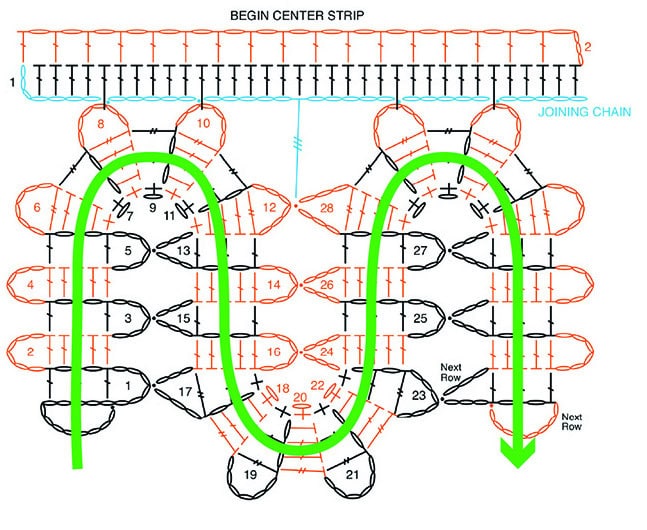
This crochet chart is read back and forth in rows, but the rows twist and turn.
- Difference #3: Crochet stitches aren’t always oriented in the same direction. Some stitch patterns have you work into the sides of stitches, around the posts of stitches, or behind and in front of other stitches. This means you really need to watch the orientation of the symbol placement in your crochet chart. The symbol not only represents what type of stitch to make, but where to make it.

The circled stitches in this chart are regular double crochet stitches, but oriented sideways as they are worked perpendicular to the rest of the row.
Crochet symbols
Just like in knitting, the symbols used in crochet charts vary in appearance from source to source, but the basic stitch symbols are fairly universal. Any diagram should be accompanied by a key to decipher its specific symbols.
As a bonus, I find crochet symbols actually look fairly similar to the stitches they represent. Short stitches are represented by short symbols, tall by tall, and chains, well, look like chains. The Craft Yarn Council has a handy pdf of the most common crochet chart symbols:

How to read a crochet chart as a knitter
Where do I start?
Just like with a knit chart, you should find each row or round in the chart numbered, with the number placed next to the first stitch.
Note: Crochet patterns often begin with a foundation chain, which is the true beginning of the work and is often not labelled or numbered in charts. Think of the foundation chain as the cast on. The cast on isn’t shown in knitting charts, but the foundation chain is typically shown in crochet charts. The first row or round will be worked into this foundation chain.
Many square motifs (like granny squares) are worked in rounds from the center out. Look to the middle of the chart to find a ring of chains or a magic ring symbol – this is your start.

Your crochet chart should have numbered rows just like knit charts.
Which way do I go?
- Standard rows: Crochet charts representing standard rows are interpreted the same way as knitting charts: You read the chart from bottom to top, the chart represents the right side of the work, and each row is read in the direction you are crocheting, meaning right side rows are read right-to-left and wrong side rows are read left-to-right.

This crochet chart is red from bottom to top, and rows are read in the direction they are worked.
- Flat-round motifs: Crochet charts in rounds (as in flat round motifs like a doily, not rounds that create tubes) are read from the center out, and each round is read counter-clockwise, again, the same direction you will crochet.
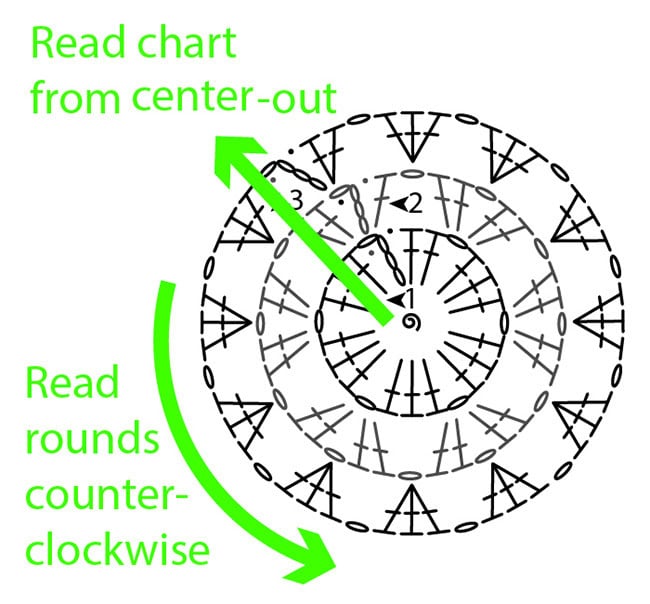
A lot of crochet charts are worked in rounds from the center-out, but these rounds create a flat piece of crochet.
- Tubular motifs: When working in the round to create a tube, crochet diagrams typically show a reduced portion of the entire round and each round is read from right-to-left.

This chart shows a stitch worked in rounds to create a tube. It fades out on either side, implying the work continues around.
- Multi-directional patterns: Multi-directional patterns aren’t very common, but can be some of the coolest projects. Patterns like these are some of the most difficult patterns to explain in text, and can really benefit from the visual information provided by a good chart.
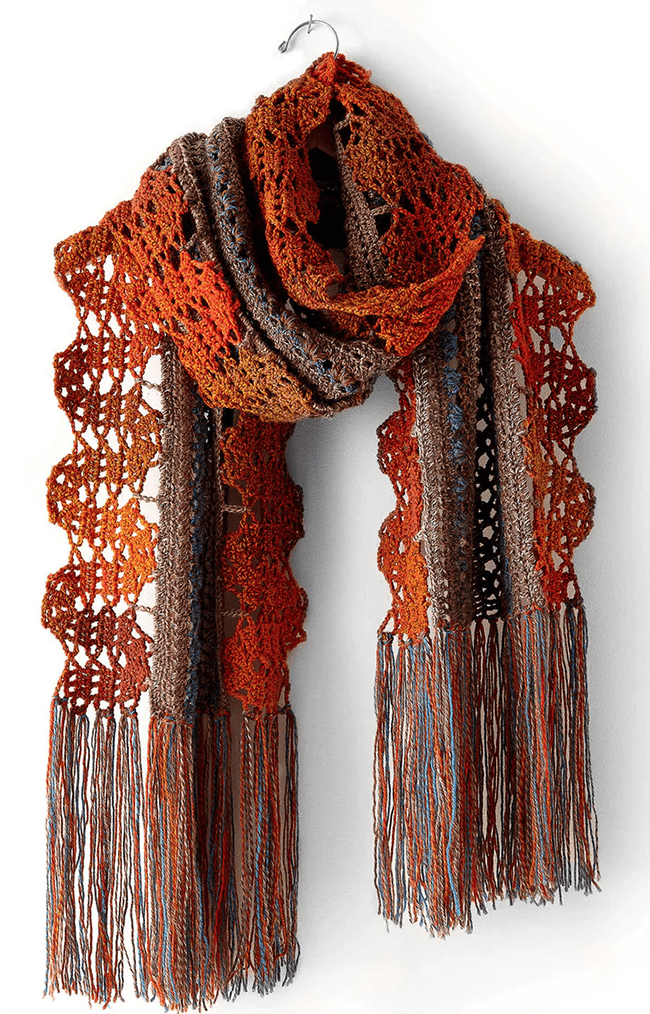
This shawl uses a stitch pattern called “Bruges Lace” which is worked in rows which snake back and forth. See the chart for this technique above under “Difference #2”.
- Are you left-handed? Many left-handed crocheters work their rows or rounds in the opposite direction from their right-handed friends. Handedness doesn’t typically affect knitting instructions, but it matters in crochet. If you are left-handed, you will need to read a crochet chart the way a right-handed person would, but the direction in which you crochet may be the opposite.

Lefties often need to read the chart one direction, but they will work their stitches in the opposite direction.
What do different colored symbols mean?
It’s fairly common to see crochet chart symbols alternate color for each row or round. Often this is just a lighter and darker version of the same color, as shown below. In this case, the color change is only to make the chart easier to read, as, unlike knitting charts, there are no gridlines to help you keep track of which symbol belongs to which row or round. The color change does not dictate a yarn color change unless otherwise specified in the key or pattern text.

This chart alternates rows of black symbols and blue symbols to help the reader distinguish one row from the other.
What about amigurumi and Japanese charts?
Crochet charts in other languages really don’t look any different from those published in English patterns. Just like with knitting, you can often follow a pattern in another language if it has a clear, well-labeled chart and the text instructions aren’t too complicated.
Japanese patterns, and amigurumi specifically, are a little different, as they often only have charted instructions. On top of that, because amigurumi are three-dimensional, the charts vary in appearance from those that represent typical rows or rounds.

This Japanese chart for a toy (amigurumi) is accompanied by a table (seen here at bottom-right). The table is read bottom-to-top and shows the round number in the left column, the number of stitches to increase or decrease in the middle column, and the final stitch count at the end of the round in the right column. This is common in Japanese patterns, which often do not include line-by-line text instructions.
Allow me to talk you through the different types of crochet charts in the video below.
Crochet charts – an overview for knitters
Personally, I love a crochet pattern that includes both text and a chart (like I did withShadowboxer or Awfully Waffly). If you’re a knitter who is new to reading crochet patterns, this type of pattern is like having a safety net: if the text has you stumped, maybe the chart will make sense to you (and vice versa).
I hope this overview helps you master the art of reading crochet charts, as there is a whole world of fun charted designs out there. You’d better buy more yarn – just in case.
ABOUT THE AUTHOR
 Julia Madill is a knit and crochet pattern designer, tech editor, and graphic artist, and Knitty's new Crochet Editor. She loves sharing what she has learned in her 10+ years of experience in the yarn industry, providing others with the tools to create in their own style, voice and aesthetic. Her book, Every Way with Granny Crochet is available from David and Charles publishers.
She lives in Toronto with her partner, two daughters, a cat named Pickles and a whole lot of yarn.
Text & images © 2026 Julia Madill